
For nearly a year, Judy Wanjiru kept returning to a health facility in Dandora with heavy bleeding and severe back pain. Each time, she was given medication for the pain. Each time, she was told to go to Kenyatta National Hospital (KNH). Unfortunately, because of her financial situation, each time, she could not afford the fare.
“I knew I was sick, but I did not know where the sickness was,” she recalls. “I was bleeding heavily, and my back hurt so much that sometimes I would even faint,” said Wanjiru.
She added; “I would go to a hospital in Dandora, and they would send me to Kenyatta National Hospital. But I stayed for about a year without going because I did not have the money to travel from Dandora to Kenyatta. I would go back, get painkillers, and when they were finished, I would return again.”
Then her church trip to Nakuru offered free cervical cancer screening, an exercise started by a bishop whose wife had died of cancer. He wanted other women to have the early screening his wife never had.
The result was stage 2B cervical cancer. She was told not to stay in Nakuru but to return to KNH. Once again, the referral came with a cost she could not meet.
“The next morning, I told the bishop who had brought us there that I had been screened and found with cervical cancer, and told to go to Kenyatta, but I did not have the fare,” she says. “I asked him to help me get the money, and I begged him not to tell anyone.”
Because of the magnitude and urgency of the issue, the bishop did not keep this critical information to himself. He called the other women on the trip, explained her situation and asked them to contribute. They raised the money, and one of them traveled with Judy to Nairobi.
At KNH, a Pap smear indicated an abnormality. A biopsy followed and confirmed what she had feared.
What followed was surgery, that removed her uterus and both ovaries; then followed with chemotherapy, radiotherapy and brachytherapy. The treatment saved her life, but it also changed the course of her family’s life.
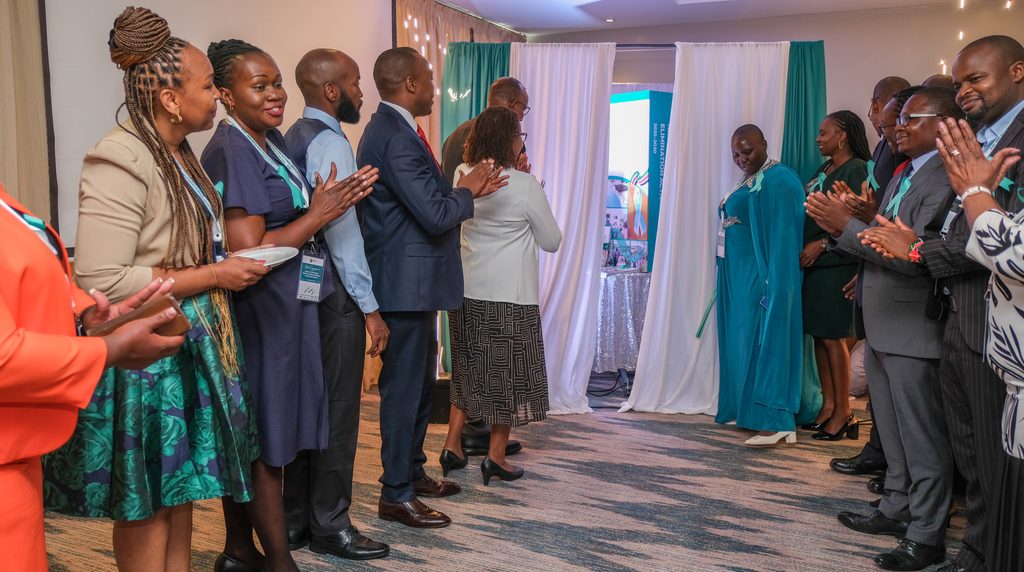
Her story points to the weak link in Kenya’s cervical cancer response. Ministry of Health launched the National Cervical Cancer Elimination Action Plan (NCCEAP) 2026–2030 in January 2026 and switched to a single-dose HPV vaccine in November 2025. Yet in Nairobi and Lamu, women still lose their lives between a referral and reaching treatment. The causes are financial constraints, scan fees, fear, late presentation and a health cover that does not yet reach every stage of care.
The ambition
Cervical cancer is caused by persistent infection with high-risk types of the human papillomavirus (HPV), mainly types 16 and 18, and is largely preventable through HPV vaccination, early screening and timely treatment of precancerous lesions.
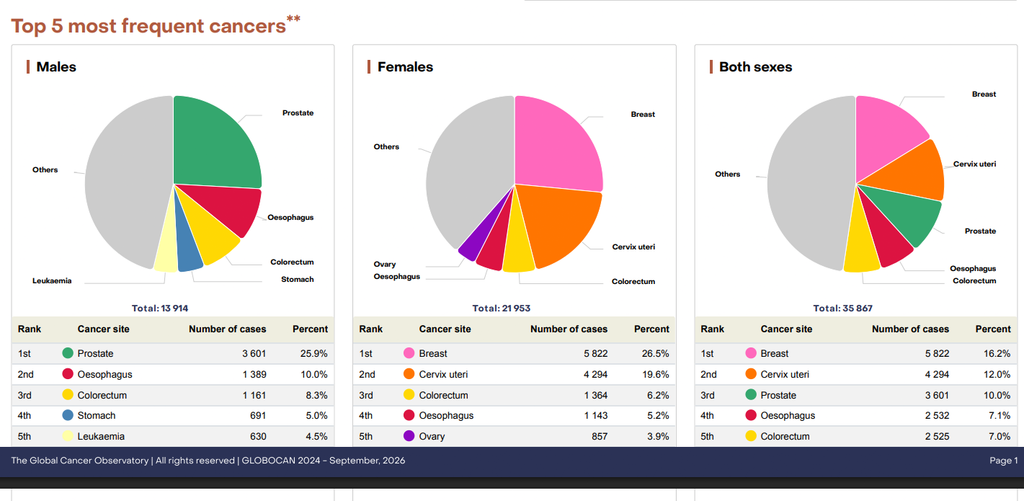
The International Agency for Research on Cancer’s GLOBOCAN 2024 estimates put Kenya’s annual burden at 4,294 new cases and 2,606 deaths. It is the second most commonly diagnosed cancer among Kenyan women, after breast cancer, and the second leading cause of cancer deaths among them.
Kenya has established policy frameworks to reduce this burden. The National Cancer Control Strategy (NCCS) 2023–2027 sets out the broader national approach to cancer prevention, early detection, diagnosis, treatment, palliative care, survivorship, financing and coordination. It seeks a coordinated and responsive cancer control framework that reduces mortality and improves the experiences and quality of life of patients living with cancer by 2028.
The National Cervical Cancer Elimination Action Plan (NCCEAP) 2026–2030 sets out the country’s roadmap towards the World Health Organization’s 90–70–90 targets: 90 per cent of girls vaccinated against HPV by age 15; 70 per cent of women screened using a high-performance test by ages 35 and 45; and 90 per cent of women identified with cervical cancer receiving appropriate treatment. The plan’s 2024 baseline shows how far that is to go as indicated in the infographic below;
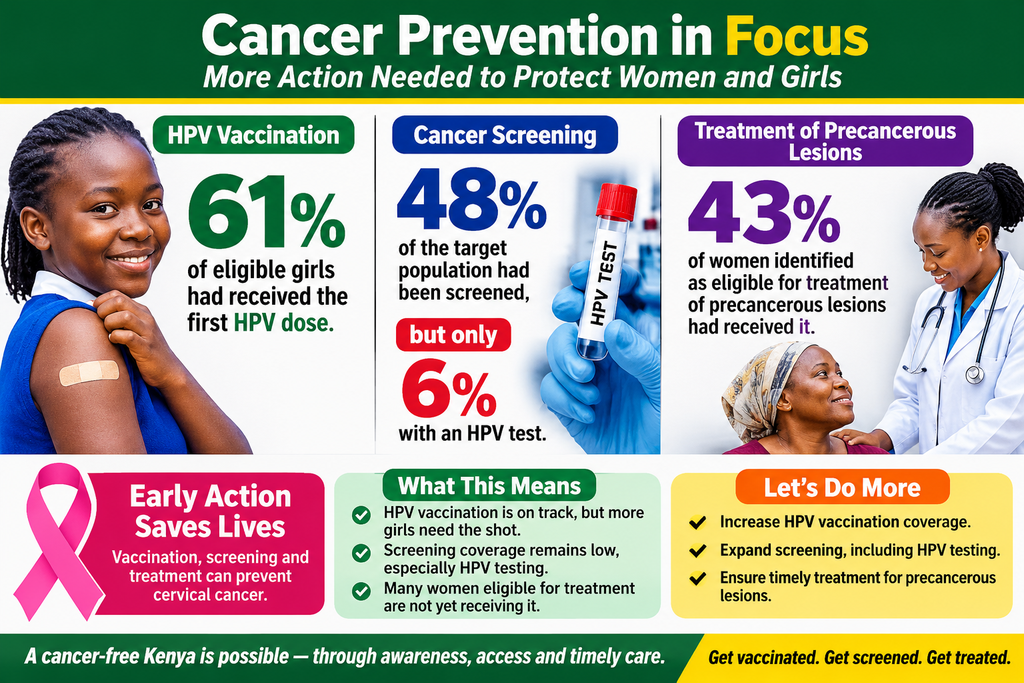
- Those figures show why elimination of the diseasecannot be achieved by campaigns alone. A woman who tests positive must be linked to diagnosis and treatment, and supported to receive full care.
Implementation rests with counties
Dr Joan Paula Bor, Head of the National Cancer Control Program (NCCP), the Ministry of Health sets policy, builds health workers’ skills and coordinates the national strategy, but service delivery is the job of counties. Each county is expected to draw up its own plan around three pillars: HPV vaccination, Screening, Diagnosis, and Treatment, and Palliative care and Survivorship.
Progress is tracked through the Ministry’s National Cancer Control Monitoring, Evaluation, Accountability and Learning (MEAL) Framework 2023–2027, which lists the indicators used to measure the NCCS’s goals of reducing cancer incidences, illness and deaths.
Dr Bor says the MEAL framework aims to establish a system that is comprehensive, fully integrated and well-coordinated to guide the monitoring and evaluation of the NCCS and serve as an accountability and learning framework for cancer stakeholders.
The framework also provides guidelines on data collection quality, supports tracking of performance against set targets, and links cancer indicators between national and county levels.
A referral is not access to the required service. Judy’s case shows what happens when that chain breaks. She sought care. A health worker recognized that she needed specialist assessment and referred her to a national referral hospital. The cost kept her away from the much-needed help for about a year. Her diagnosis eventually depended on a church’s screening exercise and on women who gave money for her journey. This is the gap between an existing service and the accessibility and use of that service by the people who need it.
The gap stretches well beyond Nairobi
In Lamu County, Dr Sudi Ali Mohamed, an obstetrician-gynecologist and fistula surgeon at King Fahad Hospital says many women reach him when the cancer has already advanced.
“Most of our patients come at stage 2A, 2B, but we also have others who come at stage three and beyond,” he says, adding that treatment at that point is harder and more expensive and a complete cure is less likely. In its early stages, the disease often has no symptoms. By the time a woman feels pelvic pain, pain during sex, or bleeding or spotting, it may have spread.
Fear and misconceptions are the greatest barriers that keep many women from accessing help in good time. Some believe the tools used to detect the disease cause it, while others doubt it exists. Effective mobilization and awareness creation in communities is also still lacking. In many communities, stigmatization is a major setback as some family members keep away from the patient, either because of lack of understanding or fear of the cost implications and expected responsibilities.
However, Dr. Sudi stresses that the medical picture is not hopeless. Under the national policy, a woman found with a precancerous lesion is treated on the spot. Early cancer can be cured with surgery, and for women who still want children the diseased part of the cervix can be removed so that they keep the uterus. Advanced cases need chemotherapy or radiotherapy.
“Cervical cancer is not a death sentence,” he says. Some of his patients who underwent chemotherapy and radiotherapy are now tumor-free and living normal lives.
The road there is hard. Many patients feel emotionally and financially drained and depressed, he says, which is why they are referred for counseling and need the support of family and community. Advanced treatment is not available in every county, so patients travel long distances for chemotherapy or radiotherapy
Lamu County Government acknowledges the limits. Dr. Mbarak Mohamed Mbarak, the County’s Deputy Governor and County Executive Committee Member for health, says that although Lamu is a marginalized county, it has used community awareness and outreaches, in which community health promoters (CHPs) sensitize residents on cervical cancer and encourage women to get screened.
“In Lamu County, we do mobile outreaches where we send trained health care workers to go to smaller areas to do screening and HPV vaccination,” he says. “In the early stages, King Fahad and Mpeketoni Sub-County Hospitals treat with cryotherapy and thermal ablation. Stage 2 and above requires an operation and chemotherapy. Lamu County doesn’t offer that, but we are working towards establishing a cancer center. For now, we refer these cases to Coast General in Mombasa or Garissa Level 5 Hospital.”
Dr Mbarak says Level 4 hospitals have been allocated funding to support treatment of non-communicable diseases, and he urges hospitals to ensure quality services and trained staff. HPV vaccination in Lamu happens in schools during outreaches, he says, but myths and misconceptions reduce uptake. He calls for more funding and partnerships to expand interventions and community awareness.
Nairobi: services exist, but who is reached?
In Nairobi, cervical cancer prevention is available in public facilities. Robert Rianga, who coordinates cancer and palliative care services for Nairobi County says thatscreening methods include visual inspection with acetic acid (VIA), HPV molecular testing and Pap smears, with colposcopy at selected hospitals.
VIA is the main method used in public facilities, he says, because it is affordable and reaches women who could not pay for the more expensive tests, in a city with a large urban poor population. The county screens between 55,000 and 65,000 women a year, and national coverage stands at around 48 per cent. The county relies on community health promoters, facility-based health education and integrated outreach to draw women in.
Mr. Rianga says that the county sets screening targets for each facility but it does not hold screening data by ward. That points to a distinction at the heart of this investigation. Having screening services in a county does not mean women are using them, receiving their results or completing referrals. The Clinton Health Access Initiative (CHAI) says weak referral, tracking and follow-up systems mean that many positive screenings and confirmed cases never complete the care pathway. The county’s screening figures need to be read alongside how many women get abnormal results, how many are referred, how many reach treatment and how many are lost along the way.
Who pays?
The government announced a rise in the Social Health Authority’s (SHA)annual cancer cover from Sh550,000 to Sh800,000, effective December 2025. The oncology package is meant to support diagnosis and treatment, including chemotherapy, radiotherapy, brachytherapy, surgery and relevant investigations, subject to benefit rules and contracted facilities.
In early 2026, however, the Kenya Cancer Network (KENCO) said patients were still paying cash because hospitals could not apply the higher limit until tariffs were formally gazetted. SHA rolled out the revised package in May, and is yet to respond on current implementation.
The NCCEAP 2026-2023 also names the Primary Healthcare Fund, the Social Health Insurance Fund and the Emergency, Chronic and Critical Illness Fund as financing routes for elimination work. These are important commitments. The criticaltest is whether patients can use them when they need to.
For Judy, access still comes with conditions. SHA, she says, pays for chemotherapy and radiotherapy, but only if the member is registered and fully paid up.
“There is no free service, because you must have SHA, and it must be paid up for the whole year for scans. SHA pays half, and I have to add the other half. Sometimes you are told to go for a scan, but you do not have the money. You cannot go back to the doctor because you have not had the scan.”
A PET scan can cost up to about Sh70,000, with the patient expected to meet part of it depending on the medical cover. The question for her is not only whether she has insurance, but whether it meets the cost of the tests her doctor orders.
Benda Kithaka, The Executive Director of KILELE Health Association says the problem lies partly in how financing is applied.
“We have a fantastic framework called the SHA,” she says. “But in its implementation, we are still doing what NHIF used to do, which is fund services in the facility, as opposed to also funding the prevention pillar and the chronic illnesses pillar. When financing does not cover prevention and continuing care, patients dig into their own pockets, which can lead to financial hardship. Women may be urged to get screened, only to be put off when an abnormal result brings more costs,” said Kithaka.
The burden follows women home
For Judy, the diagnosis did not stop with her. She was 38 and had not finished having children when she was diagnosed in 2012. She was also the family’s breadwinner.
“I was the one providing for the family,” she says. “My first-born was in Form Four. When he heard that I was sick, suffering from cancer, it affected him so much. He sat his exams and passed. I could not afford to send him to university. I could not continue working as I used to. I still had to look for food for the family, pay school fees and go for treatment. There were other children who also needed to eat. I could not manage to take him to university,” she added.
She says that cancer can also bring poverty and strain marriages. When the disease enters the homes, it brings poverty. It can even cause separation between a husband and wife.
Her message to the society at large is direct: ‘if a woman is diagnosed, do not leave her alone. Hold her hand, walk with her financially, emotionally and socially. It will take us all, rising up to be counted, to fight and win this battle against cancer.’
She now spends her days telling other women what she wishes she had known.
“Sometimes women say that screening is painful,” she says. “But I tell them it is better to go and be screened than to find yourself where I found myself.”
Her work encourages women to seek care earlier. But the responsibility for closing the gap cannot rest on survivors, community health promoters or churches raising transport money.
The test of Kenya’s elimination plan will be whether the health system can take a woman from her first screening to her last necessary follow-up without leaving her to navigate the journey alone.
A referral should lead to care. A diagnosis should lead to treatment. And finishing treatment should not mean a woman is left to pay for staying well on her own.
This story was produced with support from the Mbegu Collaborative Journalism Fund under the SAFIRI Program.

