
Marvis Murusa, a content creator, has built a following of more than 700,000 across TikTok and Facebook, attracting brands seeking her services. On some days, she works with as many as five, shooting content, posting for clients and going live for hours.
She also sells clothes through TikTok, using mannequins – commonly referred to as dummies – to display items to her followers.
For Murusa, known online as Sue Babeto, TikTok is more than a place to share videos or go live. It is a source of livelihood, but that can be disrupted without warning.
She recalls an incident when TikTok ended her live session as she was selling clothes. The platform notified her that the session had been stopped because the dummies were “naked”.
Around mid-2025, TikTok restricted Murusa’s access to live sessions for a month after viewers reported a live session in which she was promoting an electrical shop. The session was cut off just when a customer was placing an order. Murusa got a notification that people had reported her account for allegedly violating TikTok’s community guidelines.
She appealed in writing, explaining that she had done nothing wrong, and regained access to live sessions after about seven days. However, she says she lost the client.
“If you were selling, you would definitely lose clients,” she says.
Murusa believes some viewers may report creators maliciously and maintains a backup account as a safeguard against lengthy restrictions which could affect her work.
“If they give you a one-year ban, even if the allegations are not true, you will have to wait for that one year,” she explains.
Content moderation
According to TikTok’s community guidelines, the platform uses automated systems and human moderators to moderate content. It also says users are notified when their content is removed or restricted, given an explanation for the decision and allowed to appeal.
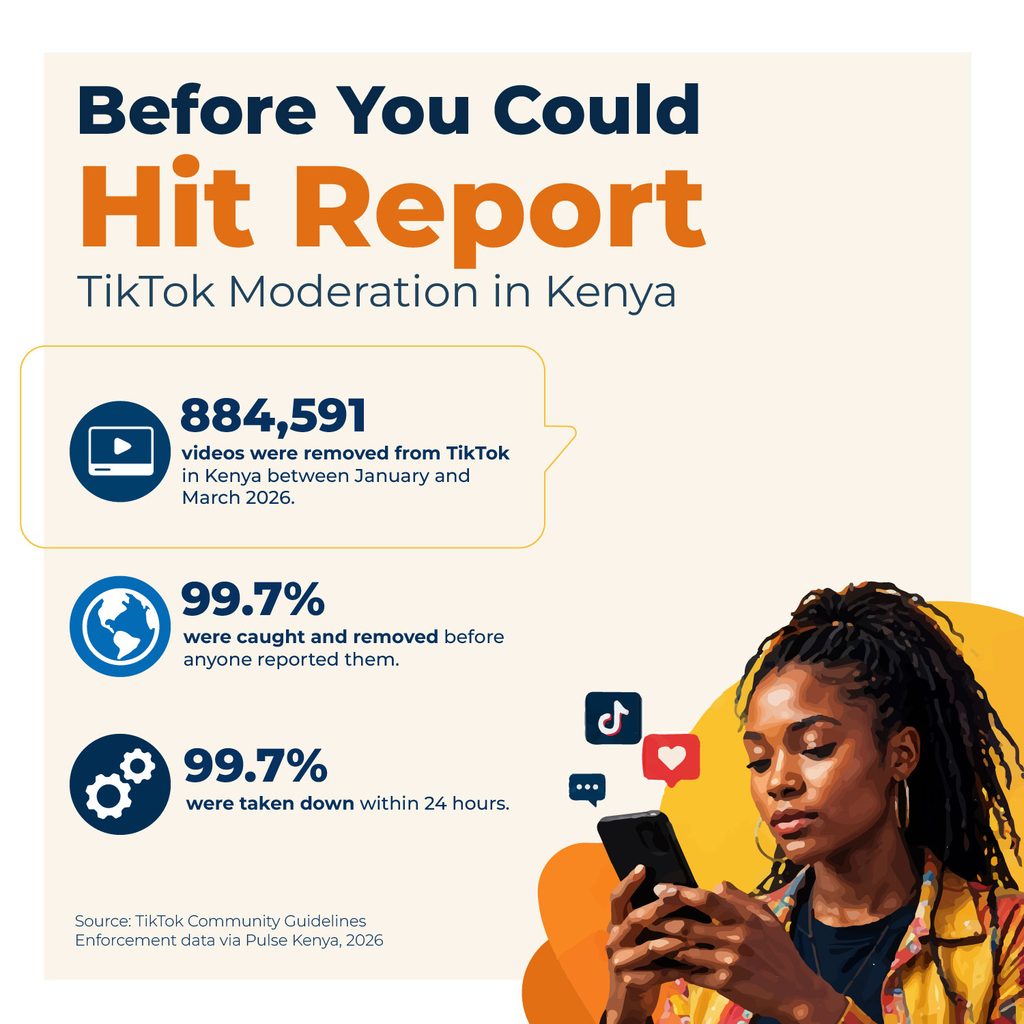
In the first three months of 2026, TikTok reported removing nearly 884,591 videos in Kenya, of which 99.7% were detected and removed before users reported them. Most (96.3%) were removed within 24 hours. Its European disclosures show automated systems making 94% of enforcement actions without human review in the first six months of 2026.
Automated moderation allows social media platforms to process volumes of content at a speed that would be difficult to review through human moderation alone. However, identifying patterns at scale doesn’t mean these systems can interpret the context in which content appears. A word, image or phrase can carry different meanings depending on the language, community or context in which it is used.
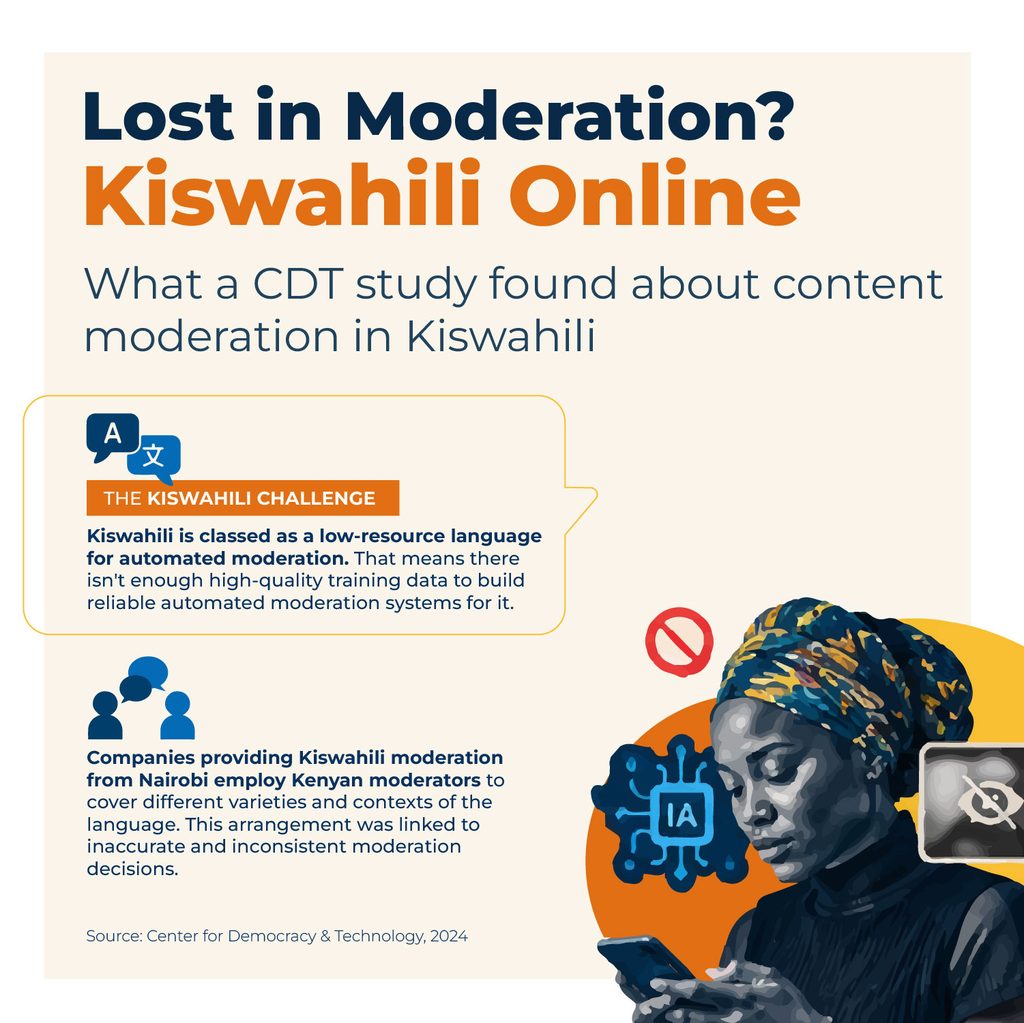
Kiswahili, for instance, is classified as a low-resource language, which means there is insufficient data to train automated moderation systems.
The Center for Democracy & Technology (CDT) surveyed Kiswahili-speaking social media users and interviewed moderators, creators and digital rights advocates in Kenya and Tanzania, and found that variations in Kiswahili, local context, slang and coded language pose challenges for content moderation.
Although TikTok tailors some enforcement to East African contexts, CDT found that relying primarily on Kenyan moderators to review Kiswahili content from across the region can lead to inaccuracies and inconsistencies in moderation decisions because of regional language differences.
For creators who depend on engagement to attract clients and brand partnerships, inaccurate content moderation can come with economic consequences. Even when content remains online, it may become ineligible for recommendation to wider audiences depending on a platform’s rules and enforcement decisions.
However, a decline in reach isn’t always a sign that a platform has suppressed a creator’s content. Reach can fluctuate for several reasons, including changes in recommendation systems and audience behaviour.
Self-censorship
To avoid falling foul of content moderation rules, some content creators have changed how they communicate online.
Murusa says the restrictions she faced made her more cautious about what she posts and says on TikTok.
“I live in fear of my account being taken down,” she says.
The fear of content moderation has also influenced what Gigi Akinyi posts online. Akinyi, a digital content creator since 2019, built a business in Kisumu using the audience and trust she has established online.
Unlike Murusa, Akinyi has never had a post removed, or her account restricted or demonetised. However, concerns about how automated systems handle content on topics like sexual and reproductive health shape what she says online.
Akinyi says creators have to think carefully about the words they use because automated systems may not distinguish between educational information and content that violates a platform’s rules.
She questions whether words such as rape, vagina or penis should automatically be treated as inappropriate when they are being used for awareness and education.
“I don’t think the word rape should be censored because it is as serious as the word is. Sometimes when you change the words, you lose the gravity of the situation,” she says.
“I know how to modify my language in case I want to communicate something of importance,” she adds.
TikTok states that it allows exceptions for certain public interest content, including educational, medical and scientific material, although such content may still be subject to restrictions on recommendations and additional warning labels.
Concerns about restriction on women’s health content have been documented internationally. A 2025 report by the Center for Intimacy Justice examined the experiences of non-profit organisations, businesses and content creators in more than 180 countries, including Kenya. It documented the suppression of sexual and reproductive health information on menstruation, menopause and abortion, across Meta, TikTok, Google and Amazon.
For women who depend on digital platforms for income, the consequences of a restriction extend beyond losing access to a post; it could mean losing audiences and sales.
Need for transparency and accountability
While social media platforms need rules to address harmful and abusive content, creators say the rules are often not applied accurately or with sufficient consideration of context.
In 2022, ARTICLE 19 published a report identifying concerns about content moderation including limited country level data, inconsistent enforcement platform rules, ineffective complaint mechanisms and insufficient consideration of local cultural, social and political contexts. The report also highlighted limited transparency and lack of access to content rules in local languages.
Miriam Beatrice Wanjiru, the programmes officer for East Africa at the Paradigm Initiative, says social media platforms need to publish more detailed data on content moderation, including information disaggregated by gender and region.
Transparent data would help identify patterns in the types of content and groups disproportionately affected by moderation decisions. Currently, some digital rights organisations, including Paradigm Initiative, provide avenues for reporting violations. Its Ripoti.Africa platform allows social media users to report digital rights violations.
Wanjiru advises creators to record when their content is removed or restricted, including taking screenshots of platform notifications and keeping copies of any appeals they submit.
For women like Murusa and Akinyi who use digital platforms to build businesses and discuss issues affecting their lives, content moderation has consequences beyond what is visible online. Restrictions can cost them clients and opportunities, while the fear of enforcement actions influences what they say. By the time an appeal is resolved, the damage to a creator’s income or audience may already be done.
This article was produced as part of the Gender+AI Reporting Fellowship, with support from the Africa Women Journalism Project (AWJP) in partnership with DW Akademie. The journalist used AI-assisted research tools to review and summarise relevant policy and research documents, surface data points for independent verification, and extract key statistics. All reporting, analysis, editorial decisions, fact-checking and final wording were done by the reporter, in line with the Lake Region Bulletin’s editorial standards.

