
As the impacts of climate change continue to intensify globally and in Kenya, the Ministry of Health has acknowledged the growing threat that changing weather patterns pose to public health.
According to Rose Mokaya, Assistant Director of Public Health at the Ministry of Health, the government is increasingly aware of the health challenges associated with climate change and is working to address its growing impact on communities.
Speaking during an engagement with science journalists during Media for Environment, Science, Health and Agriculture (MESHA) cafe, Mokaya said the ministry has put measures in place to address the effects of climate change on health.
“As a ministry, we have implemented measures such as the Climate Change and Health Action Plan 2024–2029. The plan focuses on practical action, including early warning systems for changing weather patterns and training health workers,” Mokaya explained.

How psychological impacts are often ignored
However, while efforts to address the physical effects of climate change are ongoing, experts say one area has received less attention: the psychological impact, particularly among young people.
Counselling and mental health expert Georgina Anne says discussions around climate-related disasters often focus on physical damage, loss of property and displacement, while the emotional and psychological effects are overlooked.
“When we talk about climate change, there is often more focus on the physical impacts. But when it comes to the psychological effects, they are frequently overlooked,” Georgina says.
During the floods that affected Nairobi and Naivasha last year, for instance, government agencies and non-governmental organisations focused on drainage, evacuation, the number of people affected and providing temporary shelter. However, little attention was given to the psychological toll on those who lost their homes, livelihoods and sense of security.
“When we talk about climate change, there is often more focus on the physical impacts. But when it comes to the psychological effects, they are frequently overlooked,” Georgina anne, mental health expert.
For 22-year-old Mike Mutua, the devastating effects of climate change became deeply personal when floods swept through Huruma, Nairobi, sweeping away the business he relied on for his livelihood.
After completing his studies, Mutua moved to Nairobi in search of opportunities. Through his efforts, he started a small men’s clothing boutique together with a friend who worked as a fashion designer.
The business had begun to provide them with a source of income as they tried to build their lives as young people.
“We had ordered our stock the previous day and had not even started selling it. Then the floods came and swept away items worth Sh80,000,” Mutua says, his voice trembling.
The loss left Mutua devastated. The business represented his hopes of building a better future in an economy where opportunities are already difficult to find. With his plans suddenly disrupted, he returned home.
“For me, that was the biggest setback I have experienced in my journey. Even now that I am here at home, the loss still comes to my mind,” he says.
Mutua and his friend have since stepped away from the business as they look for capital to rebuild their livelihoods. But one question continues to trouble them, where will they begin again?
Mutua is not alone. Many young people have experienced significant losses as a result of climate-related disasters, including floods, droughts and heatwaves. Unpredictable rainfall has also disrupted education and agriculture, putting additional pressure on families and young people.
Links between climate change and mental health
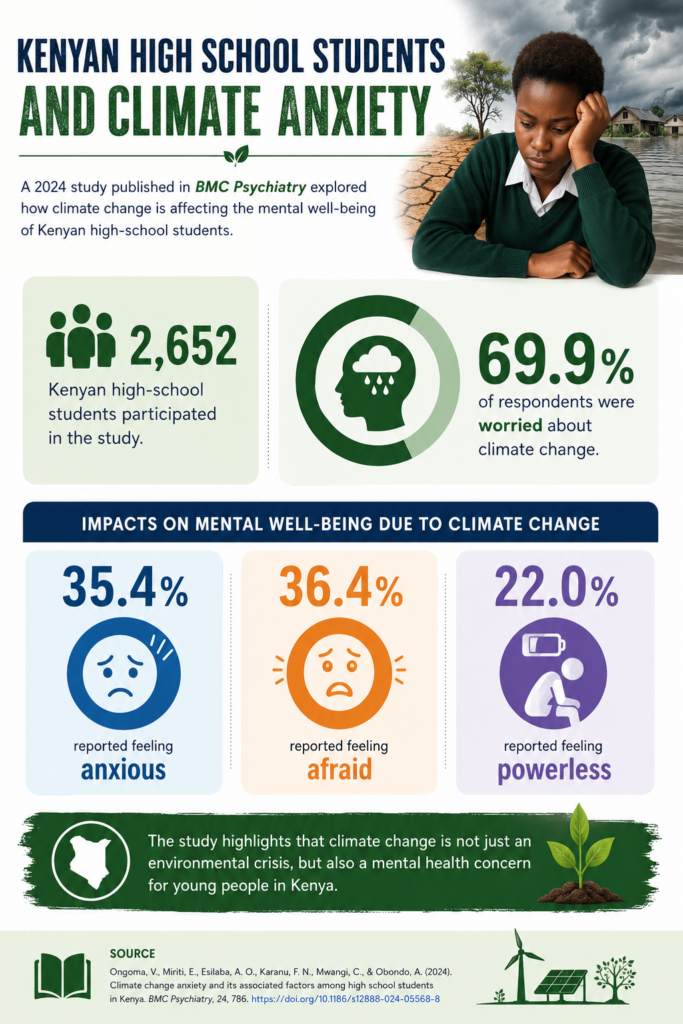
A 2024 study published in BMC Psychiatry, involving 2,652 Kenyan high-school students, found that 69.9 per cent of respondents were worried about climate change. The study also found that 35.4 per cent reported feeling anxious, 36.4 per cent afraid and 22 per cent powerless because of climate change.
Researchers found significant links between climate-change concerns and emotional symptoms, conduct problems and difficulties with peers. They also reported an association between climate-change experiences and suicidality.
The effects can become even more severe when climate-related disasters lead to food insecurity, poverty and disruption of education. Some young people may miss school as families struggle to find food or recover from the loss of their livelihoods. Others may leave home in search of income, exposing them to further risks and trauma.
For some young people, the effects of a climate disaster do not end when floodwaters recede or drought comes to an end.
“Repeated exposure to climate-related shocks can leave people experiencing anxiety and trauma long after the immediate danger has passed. For instance, a mother whose house has been flooded more than once may wake up and immediately check whether water has entered the house again,” Georgina explains.
She says such experiences can contribute to post-traumatic stress and other psychological problems. Climate-related losses can also affect young people’s education and future plans. When family livestock die during drought, for example, the money set aside for school fees may disappear with them, forcing a young person to drop out of school.
Copping mechanisms
According to Georgina, pressure to find food or earn a living may also push some young people into risky behaviours, including sexual exploitation.
Climate-related hardship can therefore affect young people not only psychologically but also through the decisions they are forced to make in order to survive.
Her concerns are supported by a 2025 peer-reviewed study, Towards a Net-Zero Healthcare System in Kenya, which highlights climate-related health risks among vulnerable communities, including young adolescents living in informal settlements, fishing communities and pastoralist areas.
The study found that climate change and extreme weather events worsen existing challenges such as food and water insecurity. These conditions can contribute to school absenteeism, sexual violence, transactional sex and other reproductive health risks.
The psychological response to climate-related disasters also varies from one person to another.
“Some young people turn to risky behaviours, including drinking or going out more often in an attempt to clear their minds. Others withdraw from people around them, even when they were previously social,” Georgina says.
“Some develop negative self-talk, telling themselves they will not succeed after previously believing they would. Harmful responses can also include self-harm or deliberately getting into fights as a way of experiencing physical pain,” she adds.
Georgina says young people are already dealing with pressures related to education, unemployment, relationships and family expectations. Climate-related losses can add another burden.
“When a livelihood disappears because of drought or excessive rainfall, that additional loss can derail a young person’s plans,” she explains.
She says responses to climate disasters often focus on physical infrastructure and immediate survival, while the psychological consequences receive less attention.
“For instance, building drainage systems and demolishing houses along riverways are some of the measures taken to respond to flooding. But there is often less attention given to the person who has been displaced and how they are adapting to their new environment,” Georgina says.
A 2025 peer-reviewed study involving 297 young adolescents in six climate-affected regions of Kenya also found that climate-related resource insecurity was affecting their psychological wellbeing.
The study identified water, sanitation and food insecurity as mental-health stressors, alongside economic insecurity, poverty and substance-use-related coping. Researchers found that lack of water generated feelings of anger and sadness among adolescents, while long queues for water could interfere with school attendance and homework.
Georgina says mental-health support should begin immediately after a disaster through psychological first aid, trauma-informed support, safe spaces for children and adolescents, mental-health screening and referrals for young people who require specialised care.
She recommends school-based counselling, training teachers to recognise signs of distress and strengthening referral systems.

At the community level, she says there is a need for psychological support groups, reintegration support for people displaced by disasters and training of community health promoters to recognise climate-related psychological distress.
The World Health Organization says climate change can affect mental health directly through extreme weather events and indirectly through displacement, disrupted livelihoods, food insecurity and damage to social support systems. Anxiety and post-traumatic stress are among the immediate psychological consequences of climate-related shocks, while longer-term effects can emerge through displacement and disruption of social cohesion.
However, Georgina says there is a major challenge in identifying people whose distress is serious but does not immediately appear to require specialised care.
“There is always someone who withdraws and experiences persistent anxiety but does not use alcohol and has not reached a suicidal crisis. Therefore, they may not fit easily into existing services,” she explains.
She adds that Kenya also has a limited number of psychologists. While counselling services in general hospitals can provide support, they may only be able to address cases to a certain level.
Georgina also points to gaps in climate-and-mental-health data and the limited number of specific interventions available for people experiencing climate-related psychological distress.
She questions what mental-health professionals should address first when someone is affected by climate change: the drought, the loss of livestock or the wider disruption to the person’s life.
For her, the absence of clearly established referral pathways remains a major gap.
As Kenya continues to experience floods, droughts, heatwaves and other climate-related shocks, experts say addressing the crisis should go beyond protecting homes, roads, farms and other physical infrastructure.
For young people like Mutua, climate change can mean more than losing property. It can mean losing a business, a source of income, a sense of stability and, in some cases, confidence in the future.
The challenge, experts say, is ensuring that as Kenya prepares for the next climate-related disaster, mental health is treated as part of the response rather than an issue addressed after everything else.
This story first appeared in Sayansi Magazine ©MESHA Features
By Kelvin Matuku

