When Lian Achieng, a Grade 7 student at Kibos School for learners with visual impairment, retrieves her class notes from an Orbit Reader 20 device without asking a teacher for help, she experiences something many learners take for granted: independence.
Using her fingertips, she reads rows of raised dots on the device’s refreshable Braille display. The Orbit Reader, a portable digital assistive device and note-taker, converts digital text into Braille, allowing learners to read, store, and retrieve academic work.
“Unlike the bulky Braille books we used before, I can now read my notes and refer to my work whenever I need to without depending on anyone,” says Lian.
Lian is one of 81 learners – 14 in Grade 6 and 67 in junior secondary school – sharing 58 such devices available at the school.
Before the devices were introduced at the mixed boarding school in Kisumu County, the students relied solely on Braille books.
“Reading braille books can be tedious because they are bulky. This technology has brought a positive change in learning,” says Caroline Templar, the head of the institution.
Hurdles in accessing the technology
Research from integrated secondary schools in Kenya’s South Rift counties found that assistive technologies increased learner participation in class and peer collaboration, while also contributing to better academic performance.
However, not all students have access.
“The gadgets are very expensive, and the ones available are not enough for all learners. Students have to use them in turns,” says Templar.
The gap extends beyond Kibos. Across Kenya, many learners with disabilities still lack the assistive technology needed to participate fully in learning. An audit report on the provision of education to learners with special needs by the Office of the Auditor General, covering the period from 2019 to 2024, found that schools lacked adequate learning materials and assistive devices, which slowed down learning. The report attributed this to insufficient funding.
Expanding access to assistive technology like Orbit Readers, which cost US$799 (about Sh103,000),is often dependent on donor support. Templar says Kibos received the devices about five years ago through a donation from the Kilimanjaro Blind Trust Africa.
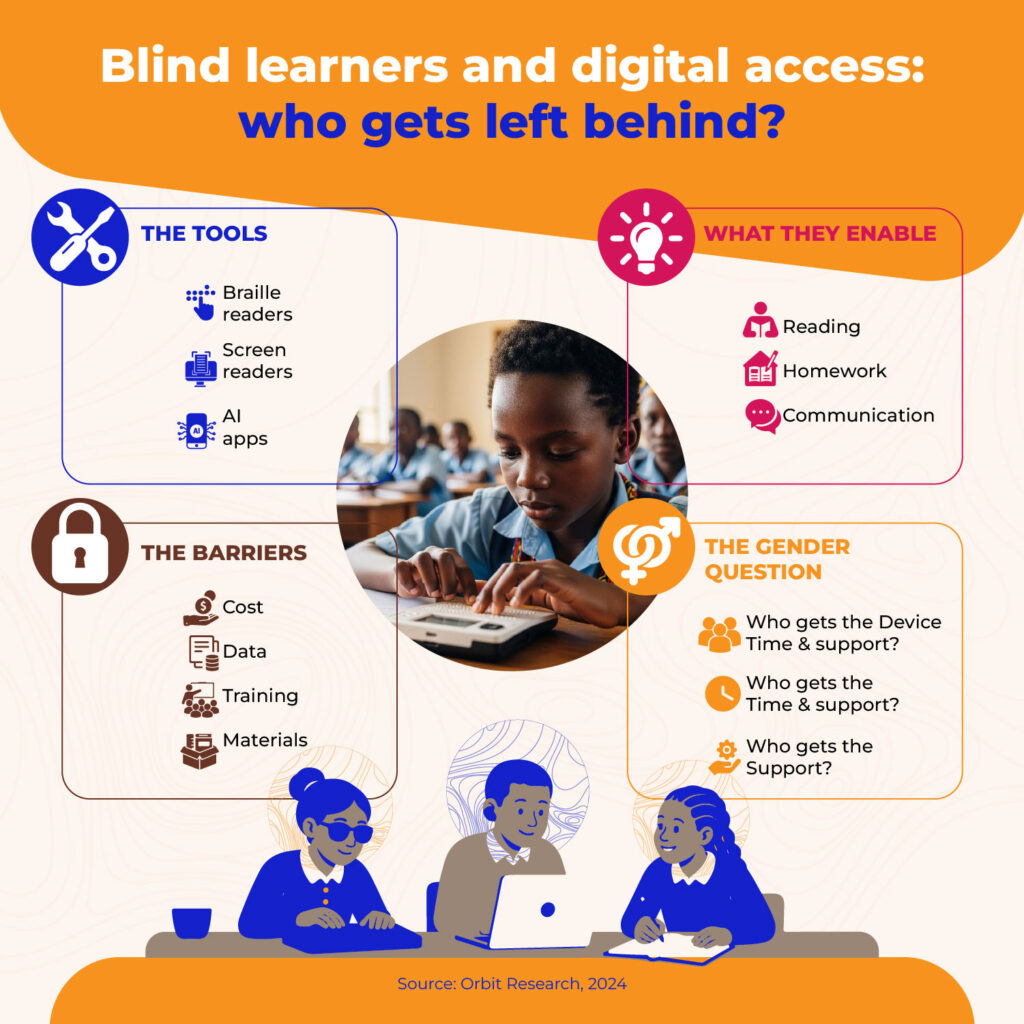
For learners with visual impairments, assistive technology is the gateway to digital education. However, due to the limited number of devices, the school prioritises junior secondary students whose curriculum places greater emphasis on digital literacy and independent learning under the competency-based education (CBE) framework.
The students attend ICT lessons four times a week, where they are taught to use screen readers like JAWS, NVDA, TalkBack and VoiceOver – assistive software programmes that read out digital text, menus, and button labels using synthesised speech or a refreshable Braille display. They help visually-impaired users navigate computers, phones and digital documents independently.
Learners who need additional support attend remedial sessions and experienced students assist their peers with navigating assistive tools. Most take about a year of consistent practice to become confident users.
Embedding Artificial Intelligence
One challenge the ICT teacher Jemima Okoth has noticed is that text-to-speech software works best with clear UK and US English pronunciation, so some learners struggle with speech clarity, while those with hearing impairments require additional support.
Moreover, while assistive technologies enable access to digital text, they cannot interpret every aspect of the curriculum.
Okoth explains that the teachers also use AI-enabled apps to make visual content more accessible. Using image-recognition applications, teachers can upload diagrams or charts and receive text descriptions that are then read aloud through screen readers.
“AI is a complementary tool. It can describe charts and diagrams, which the Orbit Reader cannot do,” she says.
Beyond screen readers, teachers also use tactile diagrams, tactile graphics, and three-dimensional models to support subjects that rely heavily on visual content.
UNICEF notes that lack of accessible learning materials is a key barrier to inclusive education. Working with the Ministry of Education, and building on the national digital literacy programme, the UN body supported the development of accessible digital books to make learning materials accessible, but educators say many learners with disabilities still face barriers.
Templar says expanding access to assistive technologies is key to improving learning outcomes and preparing learners with disabilities for a digital future. She adds that inclusion depends not only on technology, but also on equal opportunity.
While all learners with disabilities benefit from assistive technology, UNICEF says girls with disabilities face overlapping barriers linked to both gender and disability, making them less likely to access digital technologies, develop digital skills and benefit from online opportunities than boys.
According to the 2019 Kenya Population and Housing Census analytical report on disability, 20 per cent of girls with disabilities attending school had visual impairments, highlighting the importance of accessible learning materials and digital assistive technologies for their education.
Yet, access to digital skills required to use such technology and participate effectively in life after school is not equal. The 2023 Kenya National Bureau of Standards Statistical Abstract for Kisumu County shows that boys accounted for 60 per cent of participants in ICT capacity-building programmes for persons with disabilities, compared with 40 per cent for girls.
Educators warn that this gap could widen as education and employment become increasingly digital and AI-driven.
At Kibos School, teachers say the focus is not only on improving access to assistive tools, but also on ensuring learners are not excluded from opportunities to participate in an increasingly digital society.
For Lian, being able to learn independently, access information in real time, and participate more confidently in class has reshaped how she experiences education.
As Kenya moves toward a more digital future, educators say true progress will be measured by whether every learner has equal access to technology.
This article was produced as part of the Gender+AI Reporting Fellowship, with support from the Africa Women’s Journalism Project (AWJP) in partnership with DW Akademie. The journalist used AI-assisted research tools to review and summarise relevant policy and research documents, identify patterns, surface data points for independent verification, and extract key statistics. All reporting, analysis, editorial decisions, fact-checking and final wording were done by the reporter, in line with the Lake Region Bulletin’s editorial standards.

