
For Beatrice Wangoi, saving and sharing seed is not simply farming. It is a tradition handed down through generations.
So when she can exchange indigenous seed with neighbours and multiply it for the next planting season without looking over her shoulder, she considers it a small victory.
For more than five decades, however, practices that had sustained rural communities long before Kenya’s independence existed under a legal regime that increasingly treated them as a problem to be regulated.
The consequences went beyond seed.
As commercial seed regulation expanded, farmers who had for generations selected, preserved, exchanged and replanted their own varieties increasingly abandoned some of those practices. Some indigenous varieties disappeared, while others survived in the hands of a shrinking number of farmers and community seed banks.
Traditional preservation methods, storing seed in calabashes, pots, dried animal skins, ash, specially selected leaves and other natural materials, were part of an intricate body of knowledge passed from one generation to another. Villagers knew which seeds to preserve, how to preserve them and when to exchange them.
There was little thought of “owning” this knowledge. It belonged to the community.
But under Kenya’s seed regulatory system, the informal multiplication, exchange and sale of seed could expose farmers to penalties. Raids and seizures were possible where authorities suspected farmers of dealing in seed outside the formal system, and some farmers say traditional seed-storage artefacts were destroyed in the process.
That history sits uneasily beside Kenya’s emerging intellectual-property regime.
Temporary reprieve from the punitive seed law
Can a new Intellectual Property (IP) law finally protect knowledge that the old regulatory system helped push into the shadows—or could another layer of regulation bury it altogether?
For Wangoi and other farmers, the turning point came in November, when a court ruled in favour of indigenous farmers challenging provisions of the Seeds and Plant Varieties Act. The contested provisions had restricted traditional practices including saving seed from one harvest for the next, exchanging seed with neighbours and selling small quantities of indigenous varieties.
Under the provisions challenged by the farmers, dealing in unregistered or uncertified seed could attract penalties of up to KSh1 million or two years in prison.
The relief, however, remains cautious.
The government has appealed the ruling, leaving farmers uncertain about whether the legal space they have gained will endure.
“We have been meeting as we prepare on how to counter the appeal by the government, which wants to reinstate the laws that we feel are outrightly infringing on our traditions,” says Wangoi, one of the petitioners.
For farmers and seed-saving groups, the issue is larger than the right to plant a seed.
It is about a culture of preservation that survived because communities shared what they had. A farmer could keep a variety for years, pass it to a neighbour and receive another in return. The practice helped maintain locally adapted varieties without farmers having to buy new seed every season.
When the law made some of those practices risky, farmers say, many stopped doing them openly.
Yet not everything disappeared.
Community seed banks
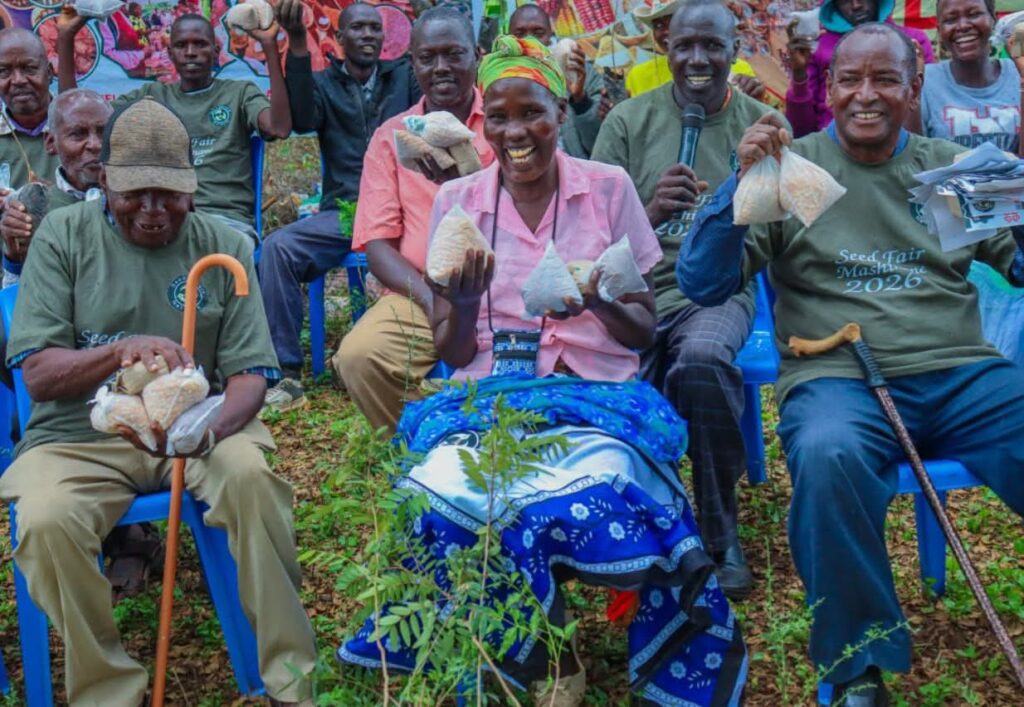
Today, community seed banks are re-emerging across Kenya’s major agricultural regions, including the Rift Valley, Central and Western Kenya. Only a handful of farmers may have continued preserving some varieties through the difficult years, but their efforts have helped seed-saving groups rebuild collections that had been at risk of disappearing.
Daniel Wanjama, CEO of Seed Savers Network, which runs a major seed bank in Nakuru, says the formal system remains largely inaccessible to the smallholder farmers who have preserved many of these varieties.
For farmers cultivating less than an acre, largely for subsistence, the commercial seed system can feel like a different world. Certified seed costs money, while formally identifying, registering or protecting a variety requires technical knowledge and resources beyond the reach of many rural farmers.
“They cannot afford it,” is the concern running through Wanjama’s argument.
The danger, he says, is that farmers could preserve a variety for generations only for a better-resourced breeder to “discover” and develop it, then seek formal protection over the resulting variety or technology.
That is where Kenya’s new intellectual-property debate becomes particularly important.
From seed regulation to intellectual property
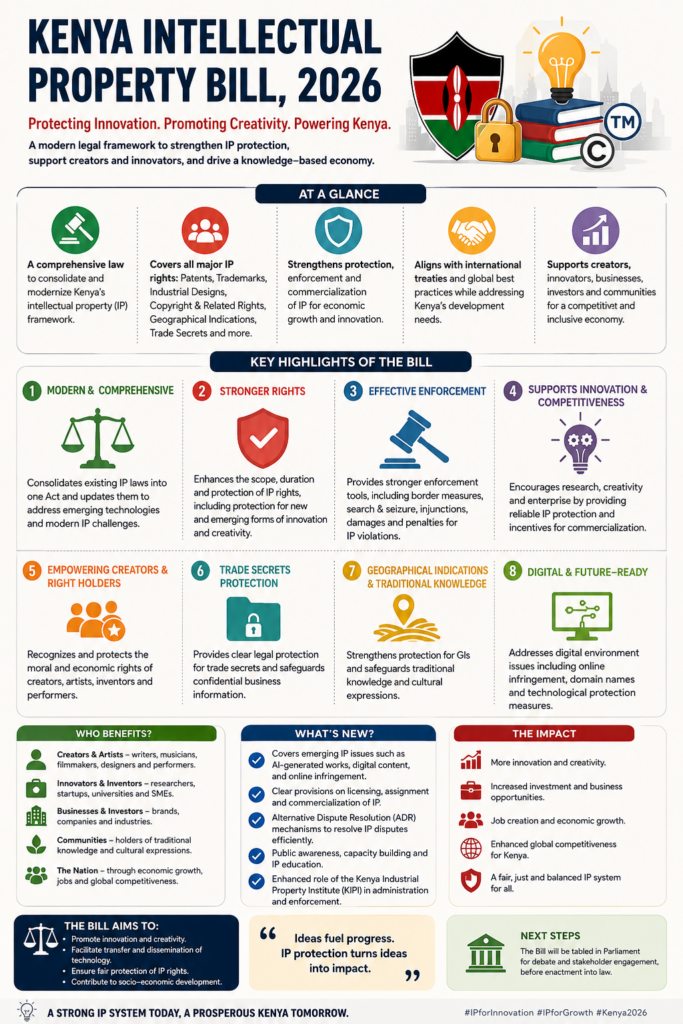
Kenya has tried before to overhaul its intellectual-property framework, including efforts dating back to 2020. The latest attempt, the Kenya Intellectual Property Bill, 2026, now before Parliament, proposes to consolidate and modernise aspects of a system that has long been scattered across several institutions.
Today, copyright is handled by Kenya Copyright Board (KECOBO); patents, trademarks and industrial designs by Kenya Industrial Property Institute (KIPI); while Kenya Plant Inspectorate Services (KEPHIS) oversees plant breeders’ rights. Other areas, including innovation, research and counterfeit enforcement, fall under different agencies.
“The proposed Bill is expected to promote job creation and wealth generation while protecting innovation, creativity and indigenous knowledge,” Kenya Trade Principal Secretary Juma Mukhwana said in Kakamega on July 31, 2026, during a public participation forum on the Bill.
For communities such as Wangoi’s, one provision could be particularly significant.
The Bill proposes that where an invention is derived from biological resources or associated traditional knowledge, a patent applicant must disclose the origin and provide proof of prior informed consent.
In simple terms, someone seeking to turn biological material or community knowledge into a patentable invention would have to show where it came from and demonstrate that the relevant community or authority consented to its use.
Failure to comply could result in the patent application being deemed abandoned.
The Bill would also give the proposed Kenya Intellectual Property Authority a specific responsibility to support and promote the protection of genetic resources, traditional knowledge and cultural expressions.
That could provide communities with a legal defence against what is often described as biopiracy, the appropriation and commercial exploitation of biological resources or traditional knowledge without proper recognition or consent.
But there is an important limitation.
The Bill does not make plant varieties themselves patentable. It maintains their exclusion from patent protection under the existing framework, while introducing disclosure requirements where inventions are developed from biological resources or associated traditional knowledge.
For farmers, that distinction is crucial.
The new law may help prevent someone from quietly turning community knowledge into a patent without disclosure. But it does not automatically give a farmer or community ownership of every indigenous seed variety they have preserved.
And that is where the promise of reform meets the reality of implementation.
Challenges facing Kenya’s intellectual property systems
At a Centre for Intellectual Property and Information Technology (CIPIT) forum on Kenya’s IP reforms on July 29, trademark lawyer Mannases Mwangi warned that the country’s intellectual-property system suffers not only from gaps in law but also from institutional and professional weaknesses.
He pointed to insufficient staffing, skills gaps and a broader failure to pay sufficient attention to expertise when hiring people to handle specialised IP matters.
Mwangi also argued that prosecution of IP offences should be handled by the relevant intellectual-property body rather than relying solely on the Office of the Director of Public Prosecutions, whose personnel may not always have the specialised understanding required to navigate complex IP cases.
The warning goes to the heart of the farmers’ dilemma.
A good law can protect knowledge only if the institutions enforcing it understand what that knowledge is, who holds it and how easily it can be appropriated.
For Wanjama, that knowledge is already being rebuilt.
His organisation works with about 200 farmer groups, many of them connected through WhatsApp, where farmers exchange indigenous seeds and knowledge about them. More farmers have joined since the court case, including communities mobilised by petitioners who argued that the seed restrictions violated Article 11 of the Constitution, which requires the State to recognise and protect indigenous knowledge, and Article 43(1)(c), which guarantees the right to be free from hunger.
Their argument was straightforward: if seed is the first link in the food chain, restricting access to it can threaten food security itself.
The bigger question now is whether Kenya’s intellectual-property reforms can reconnect two systems that have historically operated almost as strangers—the formal world of patents, registration and commercialisation, and the informal world of farmers who preserved biological resources without ever calling what they did “intellectual property”.
For decades, indigenous farmers kept their seeds alive in calabashes, pots, ash and leaves, passing the knowledge quietly from parent to child and neighbour to neighbour.
The law often saw the seed.
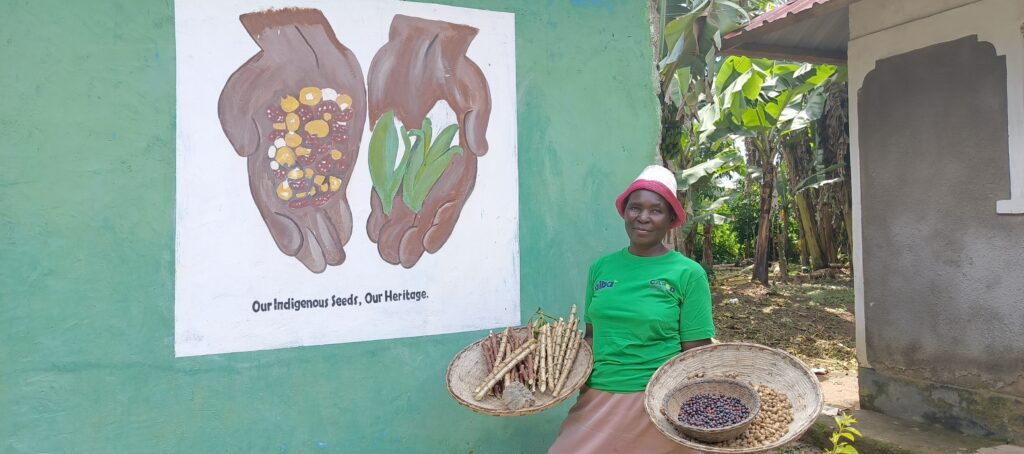
The new IP regime must learn to see the knowledge, too.
For Wangoi, the fight is therefore no longer simply about whether she can save a handful of seed for the next planting season. It is about whether the communities that preserved Kenya’s agricultural heritage for generations will finally have a meaningful legal stake in the knowledge they kept alive.
After decades in which that knowledge was pushed to the margins, the new IP Bill offers a chance to bring it into the legal light.
Like many indigenous farmers in Kenya, she did not take part in the Bill’s public participation process. But she says:
“All I want is a law that will protect our knowledge, which has helped keep food on our tables through the preservation and sharing of seeds, without fear of being arrested for doing so.”
Whether it protects that knowledge or simply gives it another set of rules to survive will depend not only on what Parliament passes, but on how Kenya chooses to enforce it.

