
As the Wednesday morning sun rose over Kisumu East, Joan Atieno was finishing her domestic chores, and then set off for her tailoring shop in Angola where she has worked for four years.
She once imagined herself working in a hospital. Dressmaking was not the future she had planned, but it has given her a livelihood and a way to begin again after pregnancy interrupted her education.
“Half a loaf is better than none” may be an old and overused adage, but for Atieno, it has become a reminder that losing one path does not mean giving up on every possibility.
Born in Konyango village in Kosele, Homa Bay County, Atieno lost her father at an early age and was raised by her mother. The second-born in a family of four children, she remembers her childhood as happy, optimistic and full of promise.
“My dream was to become a doctor, and I always had a vision of working in a hospital to help the sick,” she said.
That vision began to unravel in 2016, when she was just 16 years old, a few months before she was due to sit the Kenya Certificate of Primary Education (KCPE) examination.
But then the unfortunate discovery. “I discovered I was pregnant, and this really affected me,” she said.
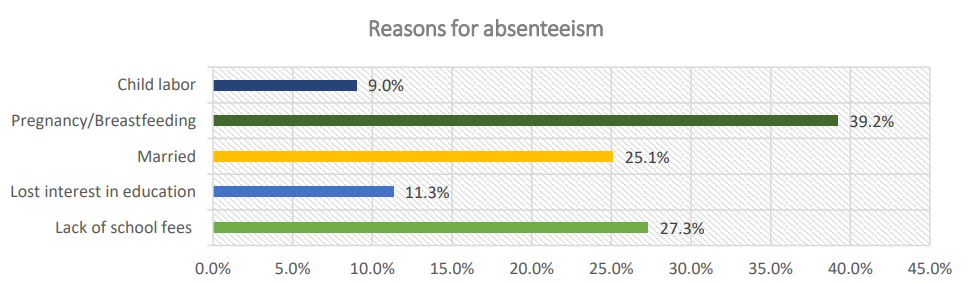
According to “Imarisha Msichana: Teen Pregnancies During and Post COVID19,” situational analysis report by Forum For African Women Educationalists Kenya, teenage pregnancy remains one of the key reasons keeping girls out of school, as indicated below;
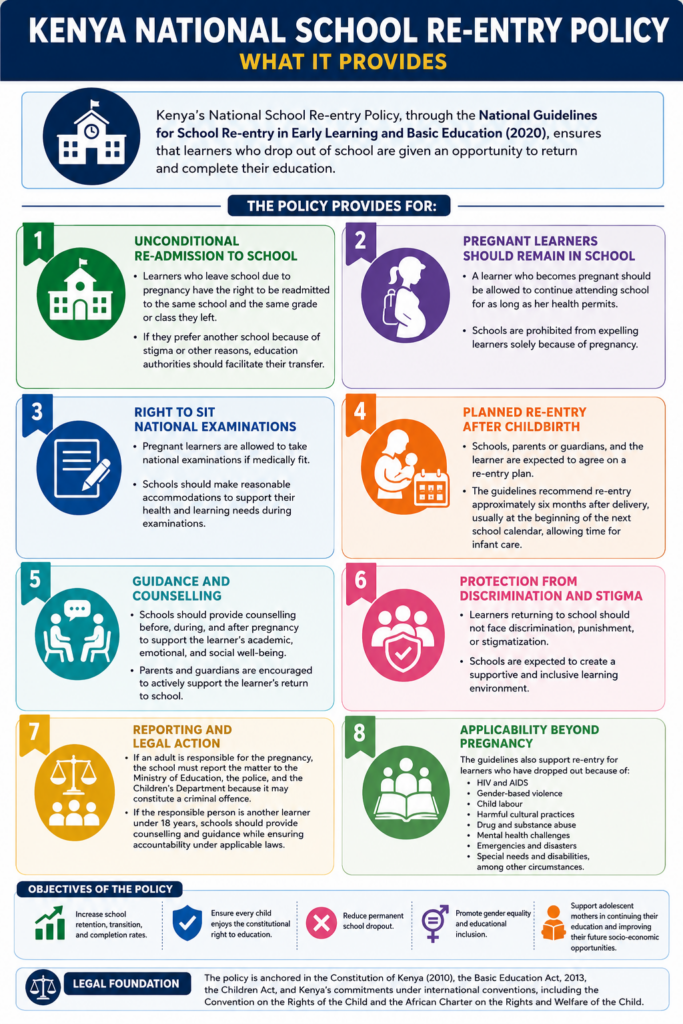
With her mother’s support, Atieno remained in school long enough to sit the national examination thanks to Kenya’s National School Re-entry Policy.
The policy formally operationalized through the National Guidelines for School Re-entry in Early Learning and Basic Education (2020) provides a framework to ensure that learners who drop out of school due to pregnancy and other factors are given an opportunity to return and complete their education.
Despite this legal cover, Atieno struggled under the weight of pregnancy, stigma and self-doubt.
“I sat the exams when I was heavily pregnant. The shame, the stigma, and the self doubt affected me so much, and I did not perform well in the exams,” she said.
Consequences of adolescence pregnancy
The following year, while her peers prepared to join Form One, Atieno gave birth to a baby girl. She did not enroll in secondary school to continue with her education.
Instead, she moved in with a relative, hoping to escape the stigma in her village while caring for her baby. Days became weeks, then months and years. Three years later, the possibility of returning to school appeared to have slipped away.
“My dream was shattered. My family could no longer raise money for my school fees, and I had also been disoriented emotionally,” she said.
In 2019, Atieno married and moved to Nyatoka village in Kisumu East. With no qualifications or vocational training, she took on menial work to supplement her husband’s income and support the family.
“With no skills, there is no decent job I could get, and I felt I was wasting myself,” she said.
Atieno’s experience shows that the consequences of adolescent pregnancy are shaped by more than individual circumstances. A young mother’s future can depend on whether her family can afford school fees, whether her community accepts her return, who cares for her baby and whether skills acquired outside the classroom are formally recognised.
According to the 2022 Kenya Demographic and Health Survey, 15 per cent of girls aged between 15 and 19 have ever been pregnant.
The survey identifies early sexual debut, child marriage, sexual violence or defilement, and limited access to reproductive health services among the factors contributing to adolescent pregnancy.
African Population and Health Research Center (APHRC, 2020) further noted that approximately 13,000 girls leave school annually in Kenya because of pregnancy.
Although the country has a school re-entry policy for adolescent mothers, stigma and financial hardship continue to prevent many from returning. Some studies suggest that only about 1,200 of the thousands who leave school eventually resume their education.
For those who do not return, the question becomes what other routes are available.
In 2021, Atieno learnt about a Make Me Smile Kenya project supporting adolescent and young mothers through vocational training and skills development.
“When I visited the centre, I was offered an opportunity to undertake a course in dressmaking. I did not look back, and today, I do not regret,” she said.
After completing her training, Atieno underwent an assessment administered by the National Industrial Training Authority. And in 2022, she received Grade Three certification in dressmaking, allowing her to compete for work alongside people who acquired similar skills through formal education.
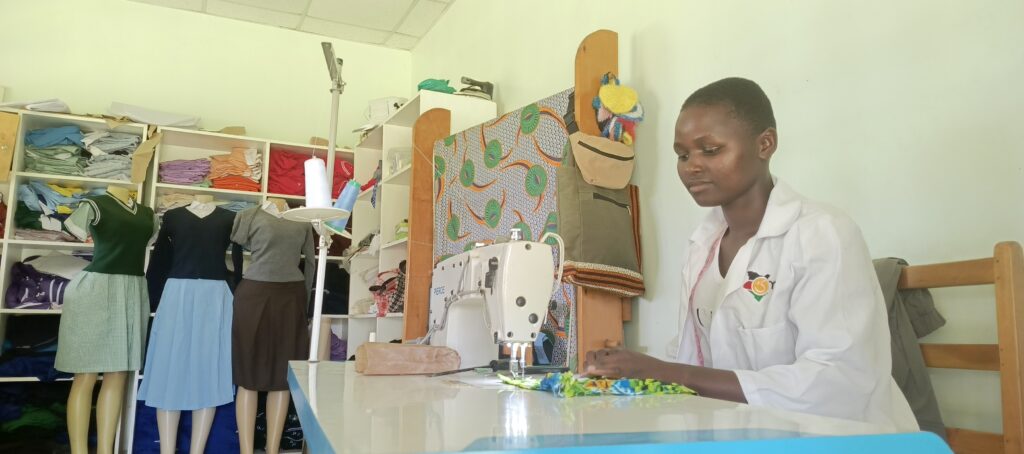
Atieno’s qualification was made possible through Kenya’s Recognition of Prior Learning policy. Developed by the Kenya National Qualifications Authority in 2020, the policy assesses and certifies knowledge and skills acquired outside formal education.
“I am currently proceeding with further training, and I have registered for assessment for Grade Two Level, and then I will move to Grade One,” Atieno said.
Recognition of Prior Learning
Data from the State Department for Technical and Vocational Education and Training showed that more than 5,000 Kenyans had received Recognition of Prior Learning certification by April 2025. Demand was particularly high in masonry, tailoring, hairdressing and motor vehicle mechanics.
The government aims to extend the certification programme to between 420,000 and 700,000 people in response to demand for skilled workers in Kenya and abroad.
“Kenya continues to receive requests for workers with different skills to work abroad. Since we don’t have such a course in our formal education system, we are now able to look at the skills required and assess individuals working in the sector so that we give them certificates to take up the job offers,” Recognition of Prior Learning Director Stanley Maindi said during a working tour of Kisumu in April 2025.
The pattern of interrupted schooling, relocation and survival work also appears in the life of Diana Owino.
Owino, now 28, dropped out of school in 2015 after becoming pregnant while in Form Three. She was barely 17. She left her rural home in Nyikendo village in Suna East, Migori County, and moved to Kisumu to live with a relative.
“I could not keep up with the stigma. I had to move away from that environment,” she said.
After giving birth, caring for her baby became her immediate responsibility. Depending on a relative for accommodation placed additional pressure on her to earn an income.
“I was now being hosted together with my baby, which is quite a huge burden to the host. I had to do menial jobs in order to get some basic needs for myself and my baby,” she said.
Owino had hoped to become a secondary school teacher. At one point, she believed marriage might offer stability, but the relationship ended.
“At one point I got into marriage, but it did not work out, and I had to rethink my future,” she said.
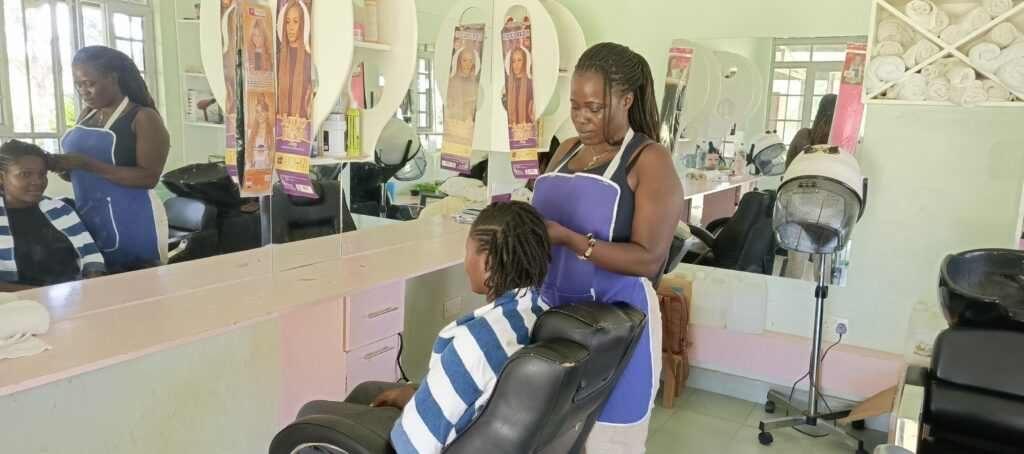
In 2022, Owino joined the Make Me Smile Kenya programme and trained in hairdressing. The work has since become her source of income.
After attaining Grade Three certification, she enrolled for Grade Two which she successfully completed this year, and is now awaiting further assessment for Grade One before proceeding to do master craft level.
Magdaline Akinyi, 23, from Ofunyu village in Kisumu County, encountered similar barriers. The youngest in a family of three children, she dropped out of school in Form Two in 2019 after becoming pregnant at the age of 16.
“I moved in with my boyfriend who was a businessman, but the union ended not long after I had delivered,” she said.
Akinyi then moved in with a relative but could not return to school because her family could not afford the fees.
She later enrolled in a hairdressing course through Make Me Smile Kenya. At the time of her interview with the Lake Region Bulletin, she had been in the programme for three months and hoped to open her own shop while developing her skills and working towards certification.
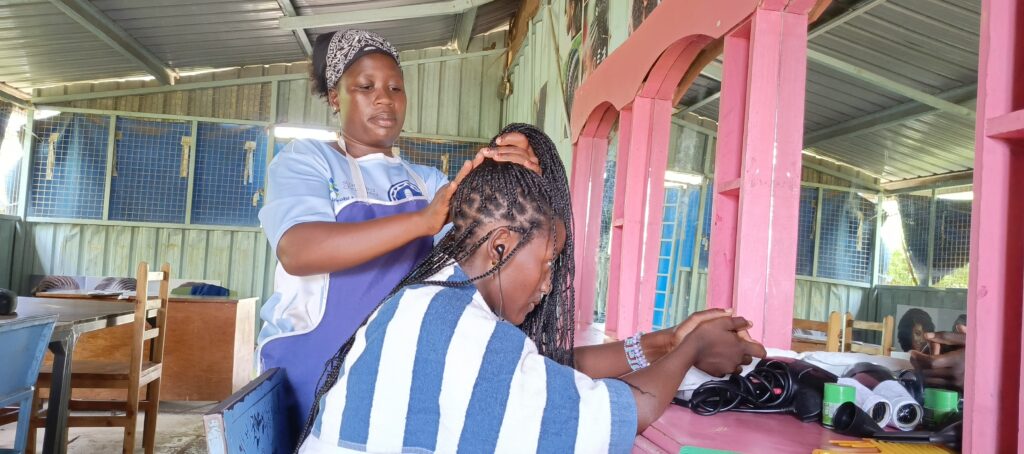
“I am glad that I have interacted with a number of my peers whose lives were turned upside down by teen motherhood but have reconstructed their lives after undergoing these programs,” Akinyi said.
Make Me Smile Project
Atieno, Owino and Akinyi are among the 524 young mothers supported by Make Me Smile Kenya across six wards in Kisumu County.
Founded in 2009, the organisation initially provided shelter and educational support to orphans and other vulnerable children. It later expanded its work to include vocational training and economic empowerment.
“With time, we started thinking about sustainability, and we introduced the skills of these beneficiaries so that they can be able to stand on their feet and support their families,” said Linda Odawo, business coordinator at the organisation’s Smiles Hub.
According to Ms Odawo, Smiles Hub, a social enterprise of Make Me Smile Kenya in Kisumu County, is transforming how young people move from training to economic independence.
The hub provides practical, hands-on training in tailoring, dressmaking, beauty, hairdressing, ICT, and solar photovoltaic systems while connecting skills development with entrepreneurship, production, and real market opportunities.
Beyond technical training, Smiles Hub creates a supportive ecosystem that addresses the realities affecting youth success through Sexual Reproductive Health Rights (SRHR) services, psychosocial support, healthcare, environmental sustainability initiatives, and childcare support for young mothers.
Through mentorship, employment pathways, and enterprise opportunities, the hub supports graduates especially Adolescent Girls and Young Women to transition into confident, skilled, and self-reliant entrepreneurs.
“We started with a tailoring course in 2018, where we had an enrolment of 13 in the first cohort. The next cohort jumped to 30, and the numbers have been growing,” Odawo said.
But skills training is only one part of the support young mothers need. According to Odawo, some participants arrive while still dealing with trauma. They receive counseling to help them recover and continue with their training.
Childcare is another practical barrier. The organisation provides daycare for participants with young children, allowing them to attend classes.
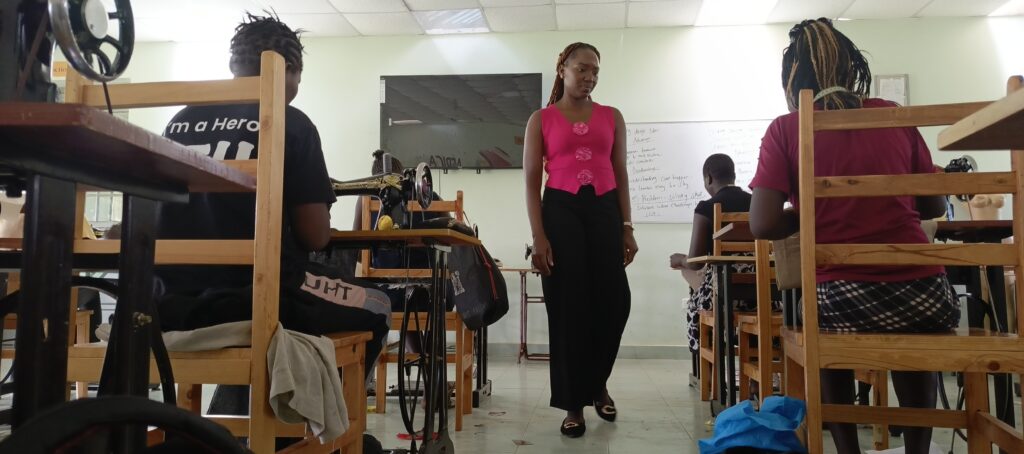
Until the time of producing this piece, the organization had trained over 2,498 people; 1,748 being females, 524 of them being young mothers.
Professor Humphrey Oborah, a champion for alternative education says there is need to invest more on talent-based education to ensure young mothers who drop out of school can still achieve their career dreams.
Prof Oborah who is the founder of The Africa Talent University (TATU) says with experience from their new found careers, Atieno and her colleagues can still attain higher certification.
“This is why the country is implementing the Competency Based Curriculum (CBC) where learners are not only certified through the traditional education which measures intelligence narrowly through standardized examinations while ignoring vast forms of human capabilities such as; creativity, practical intelligence, artistic expression, innovation, leadership, and entrepreneurial ability.”
TATU university offers non-traditional education, focuses on producing skilled professionals who are not traditionally academically endowed.
For Atieno, the path forward no longer leads to the hospital she imagined as a child. It runs through her tailoring shop, further training and the next levels of professional certification.
Her story does not erase what she lost when she could not return to school. It shows what can become possible when determination is matched by training, certification, counselling and childcare.
“I believe I can rebuild my career dream, even if it is not in the field I initially dreamt to be,” she said.
Lake Region Bulletin Young Mothers Project is part of the Young Mothers Consortium, a regional initiative supported by the Conrad N. Hilton Foundation and working across Kenya, Mozambique, and Tanzania to center young mothers’ leadership and voices.

