
Iran’s growing military relationship with the Sudanese Armed Forces (SAF) is raising broader human rights and regional security concerns.
As the war in Sudan enters its fourth year, Iranian-made drones and other military support continue to potentially strengthen the capabilities of a force accused of serious violations against civilians.
A recent open-source intelligence assessment by journalists and humanitarian organizations based in Sudan suggests that Iran has, since late 2023, become a vital source of unmanned military capabilities used by the SAF.
The report has cited Iranian-made Mohajer-6 drones, documented wreckage of the systems in Sudan and flights between Iran and Port Sudan among the key indicators.
The August 2026 assessment does not establish if Iranian combat forces are deployed in Sudan- it characterises Tehran’s role as an indirect military intervention involving weapons, technology, logistical support and defenSe cooperation.
But from a human rights perspective, the significance of that support extends beyond the question of whether Iranian personnel are physically present in Sudan.
The key concern is the risk the transfer and use of advanced military capabilities expose civilians caught in a conflict where both the SAF and the Rapid Support Forces (RSF) to. SAF and RSF have both been accused of serious abuses.
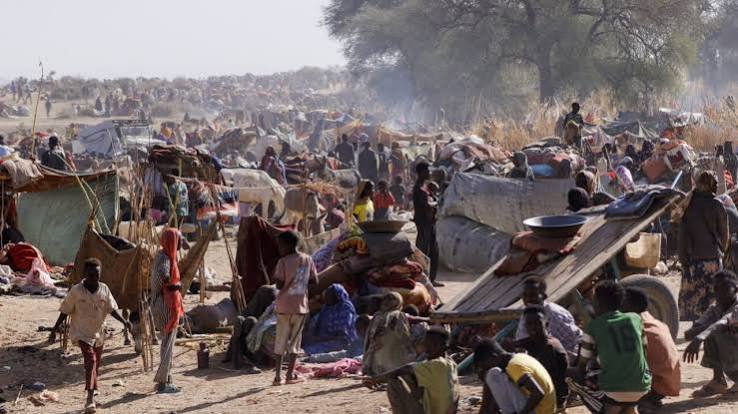
The war, which began in April 2023, has left a devastating humanitarian crisis, emerging from civilians killings, displacement, destruction of civilian infrastructure and restrictions on access to essential services.
In light of this, improved surveillance and strike capabilities could have significant consequences for civilian protection, especially if military systems are used in populated areas without adequate safeguards to distinguish between military targets and civilians.
The assessment says Iranian drones have helped the SAF improve some operational capabilities, mainly surveillance and targeting. The emergence of the technology in early 2024 came at a time when the army was seeking to reinforce its position against the RSF.
But, the assessment cautions that Iranian assistance is not the main contributor to changes in the battlefield as SAF mobilisation, reorganisation, air power, artillery among other factors have also influenced military developments.
The human rights question
The main concern is not simply whether Iran has supplied weapons to Sudan, but whether military assistance is contributing to violations of international humanitarian and human rights law.
While the use of drones can provide armed forces with greater ability to monitor movements and conduct operations from a distance, the same technology can increase the ability to conduct attacks, particularly in an urban set up where civilians and combatants are in proximity.
For civilians in Sudan, the consequences of any expansion in military capabilities can therefore be profound.
Besides the evidence of Iranian Mohajer-6 drones being used by the SAF, Human Rights Watch has independently analysed visual and open-source materials identifying the systems and documenting wreckage of the model in Sudan in January 2024.
This provides a crucial physical link between Iranian military technology and the Sudanese battlefield.
The assessment also notes six Qeshm Fars Air cargo flights between Iran and Port Sudan between December 2023 and January 2024 and while they demonstrate a logistical connection, investigators could not independently establish the contents of every shipment.
That distinction is vital when assessing potential responsibility for abuses. Evidence of weapons or military technology being supplied does not, by itself, establish involvement in a specific attack.
But it raises questions about due diligence, end-use monitoring and the responsibilities of states transferring weapons to parties involved in an armed conflict, whose implications extend beyond the Sudan’s borders.
A conflict with regional consequences
Sudan sits along the western coast of the Red Sea, placing the conflict at the intersection of African, Middle Eastern and global maritime security interests.
Iran’s renewed engagement therefore potentially gives Tehran greater strategic reach into the Horn of Africa and closer access to one of the world’s most important maritime corridors.
The intelligence assessment says Iran’s interest in Sudan appears to extend beyond arms sales, with strengthening relations with Khartoum serving broader political and strategic objectives.
Separate reports have suggested that Tehran sought a permanent naval presence along the Sudanese coast, with the assessment, finding insufficient evidence to conclude that Iran had obtained a permanent naval base or facility in Sudan.
A confirmed Iranian military base on the Red Sea would represent a substantially different regional security development from the provision of drones and other military equipment. At present, open-source evidence does not establish such a facility.
Nevertheless, Iran’s earlier naval visits to Port Sudan demonstrate that access to Sudan’s Red Sea coast is not a new feature of the relationship.
Iranian warships visited Port Sudan in October 2012, while further naval visits were reported in 2013. Those visits did not establish a permanent Iranian base, but they demonstrated Tehran’s longstanding interest in Sudan’s maritime position.
Risk of wider militarisation
The renewed relationship comes at a time when the Red Sea and Horn of Africa are experiencing increased geopolitical competition.
Greater military involvement by external powers in Sudan, is feared, could deepen an already complex conflict environment, with regional states and international actors pursuing competing political, security and economic interests.
For civilians, such competition can carry a cost if Sudan becomes increasingly militarized through the involvement of external suppliers.
The danger is not limited to the weapons themselves. Continued external military support could reduce incentives for the parties to seek negotiated solutions if each side believes it can improve its battlefield position through foreign assistance.
The result could be an extended conflict, further displacement and additional pressure on humanitarian access.
Meanwhile, Iran’s involvement cannot be examined in isolation from other external relationships surrounding Sudan. The war has become increasingly internationalised, with different actors accused or reported to have provided political, financial, military or logistical support to the rival sides.
The emergence of another external military relationship therefore risks contributing to a wider pattern in which Sudanese civilians bear the consequences of geopolitical competition.
The evidence of Iranian drone supplies also raises questions about accountability for arms transfers to parties engaged in a conflict marked by allegations of serious violations.
The August 2026 assessment says the strongest evidence concerns Iranian drones, while claims involving Iranian advisers, operators or Islamic Revolutionary Guard Corps personnel inside Sudan remain less clear.
The assessment also highlights a 2026 US criminal case involving an Iranian national accused of facilitating arms transactions on behalf of the Iranian government.
According to the US criminal complaint, the alleged activities included facilitating a contract worth more than $70 million in 2025 for the supply of Mohajer-6 drones from Iran’s Ministry of Defense to the Sudanese military establishment, alongside other military equipment and ammunition.
Responsibility based on evidence not assumptions
The allegations remain subject to the legal process and do not amount to a final judicial finding.
Nonetheless, if confirmed, such transactions would indicate that Iranian military support to Sudan was not limited to isolated deliveries during the early stages of the war but may have developed into a structured defence relationship.
That possibility increases the importance of examining whether appropriate safeguards were applied to prevent transferred weapons and military technology from being used in violations of international humanitarian law.
The legacy of Iran-Sudan ties
Iran’s current military relationship with the SAF also has historical roots.
During Omar al-Bashir’s rule, Iran and Sudan developed political, security and military links, including reported military training and cooperation in defence industries.
The two countries signed a military cooperation agreement in 2008, while Iranian naval visits to Port Sudan demonstrated the strategic importance of Sudan’s Red Sea coastline.
Diplomatic relations were severed in January 2016 after Sudan aligned more closely with Saudi Arabia following attacks on Saudi diplomatic missions in Iran.
The relationship was restored after the Sudanese war began.
Foreign ministers from the two countries met in July 2023, and diplomatic relations were formally restored in October of that year. Ambassadors were later exchanged in July the following year.
The rapid restoration of relations is significant because it suggests that the current military relationship was built partly on existing institutional experience rather than created from nothing.
The assessment gives high confidence to the conclusion that the Bashir-era military and security legacy facilitated the rapprochement.
It gives only medium confidence, however, to claims that Islamist and former-regime networks directly organised the current Iranian-Sudanese cooperation.
What it means for civilians
For Sudanese civilians, the most immediate concern is whether increased military capability will translate into greater protection or greater exposure to violence.
Iranian drones could potentially improve surveillance and targeting, but their use in an active conflict also creates risks if attacks are conducted without adequate precautions to protect civilians.
The availability of more sophisticated military technology does not itself determine whether international humanitarian law will be respected. That depends on how the systems are deployed, the targets selected, the precautions taken and the mechanisms available to investigate alleged violations.
The assessment therefore points to a wider question for governments supplying military equipment to Sudan: whether their assistance is accompanied by meaningful safeguards, monitoring and accountability mechanisms.
This is particularly important in a conflict where accountability remains a major challenge and where civilians continue to face the consequences of fighting between heavily armed parties.
A wider Horn of Africa concern
Iran’s expanding relationship with Sudan could ultimately have implications beyond the immediate war.
If wartime cooperation develops into long-term arrangements involving training, maintenance, defence manufacturing, intelligence or maritime security, Tehran could establish a more durable strategic foothold in the Horn of Africa.
The assessment gives medium confidence to the possibility that the relationship will continue even if the intensity of the war decreases.
The indicators to be on the lookout for include new military agreements, official visits, defence contracts, training arrangements, military-industrial cooperation and developments involving Sudan’s Red Sea coast.
For the region, such developments could intensify strategic competition around the Red Sea and potentially draw Sudan further into wider Middle Eastern rivalries.
For human rights defenders and civilian protection actors, however, the central concern is whether the growing availability of foreign military technology contributes to greater protection of civilians or enables further escalation of a war already marked by widespread suffering.
As of August 2026, there is no sufficient open-source evidence of an Iranian occupation of Sudan or a large-scale deployment of Iranian combat troops.
But the available evidence points to a significant form of indirect military intervention through weapons, unmanned technology, logistical links and defence cooperation.
The emerging relationship therefore presents two interconnected challenges: the potential strengthening of the SAF’s military capabilities and the possibility that Sudan could become an increasingly important arena of Iranian strategic influence along the Red Sea.
For civilians, the ultimate measure of that relationship will not be the number of drones supplied or defence agreements signed, but whether the expansion of military capabilities is accompanied by stronger respect for international humanitarian law, civilian protection and accountability for violations.
STORY BY BETTY KATHAMBI
The author is a passionate journalist and storyteller committed to amplifying unheard voices, telling human-centred stories, and shining a light on issues that shape communities and inspire change.

