At 5 a.m. in Kakamega County, Irene Nasimiyu prepares for her morning radio show. Before going on air, she turns to an unexpected tool—not a notebook or a producer, but an artificial intelligence system that helps her generate story ideas, check facts, and organise her script.
Just a year ago, Irene did not think AI had anything to do with radio.
For her, radio has always been deeply human—local, conversational, and rooted in the everyday lives of her listeners. Technology, especially something as abstract as artificial intelligence, felt distant from that.
“At first, I thought radio wasn’t part of AI,” she says. “Now, I’m learning to embrace AI in my work and create more impactful programmes.”
Today, she uses AI tools to generate local story ideas, conduct research, and verify information before going on air. But applying these tools in local-language radio is not always straightforward.
“Sometimes the translations are not accurate, especially when dealing with local dialects,” she says. “You still have to correct and adapt it to fit the audience.”
In stations where language, tone, and cultural nuance matter, AI tools often fall short. Many systems are trained primarily on widely used languages, limiting their accuracy in local dialects and vernacular media. Research has consistently shown that language coverage remains uneven, particularly for African languages.
Artificial intelligence is quietly entering newsrooms, helping journalists work faster. Much of this change is driven by generative AI systems that can produce text and summarise information in real time. For journalists, this has opened up new possibilities but also new questions about accuracy, access, and control.
From curiosity to daily use
Not every journalist’s journey into AI begins with training. For Naomi Cheruiyot, it started with a colleague.
“I use AI daily to do research… I am slowly learning and embracing it in my work,” she says.
Across Kenya’s newsrooms, this pattern is common. Many journalists, particularly women, find their way into AI through peer learning and experimentation rather than formal training.
Studies of African newsrooms show informal adoption is widespread, even where policies and training structures are still developing, and younger journalists are more likely to experiment with AI.
According to UNESCO, women make up only about 30 per cent of the global technology workforce, an imbalance that is increasingly reflected in newsrooms adopting these tools.
Uneven access
For organisations like the International Association of Women in Radio and Television (IAWRT-KE), these gaps are already visible.
Rachael Nakitare, the organisation’s Programmes Manager, says many women journalists are still on the margins of technological change.
“A lot of women have not embraced technology because they do not understand its importance,” she says.
Their research shows access often depends on location and newsroom structure. Journalists in Nairobi are more likely to receive training, while those in other counties, especially freelancers and correspondents, are often left out.
“In addition, those making editorial decisions are often men, who benefit more from technological opportunities,” she adds.
To bridge this gap, the organisation has trained dozens of women journalists across the country, with many beginning to apply AI tools in their daily work.
AI in practice and its limits
In smaller and community-based newsrooms, AI adoption is often driven by necessity.
Boniface Opany, Station Manager at Radio Domus, says his station has started integrating AI into its editorial workflow to manage limited resources.
“As a community station, AI is important for us to explore, given our small teams and limited finances,” he says.
But the tools are far from perfect.
“AI can support research and scripting, but it cannot replace local knowledge or lived experience,” he says. “You still need the journalist to interpret and verify.”
AI systems can also generate inaccurate information, commonly referred to as “hallucinations”, which require careful verification. In local reporting, where nuance and context are critical, this often adds work rather than removing it.
Opany points to another challenge that goes beyond the tools themselves.
“There is a high turnover of female journalists in community media,” he says. “When turnover is high, it becomes difficult for them to develop skills with new technologies.”
Power and bias
As AI becomes more embedded in newsrooms, it is changing how stories are produced and influencing which stories get told.
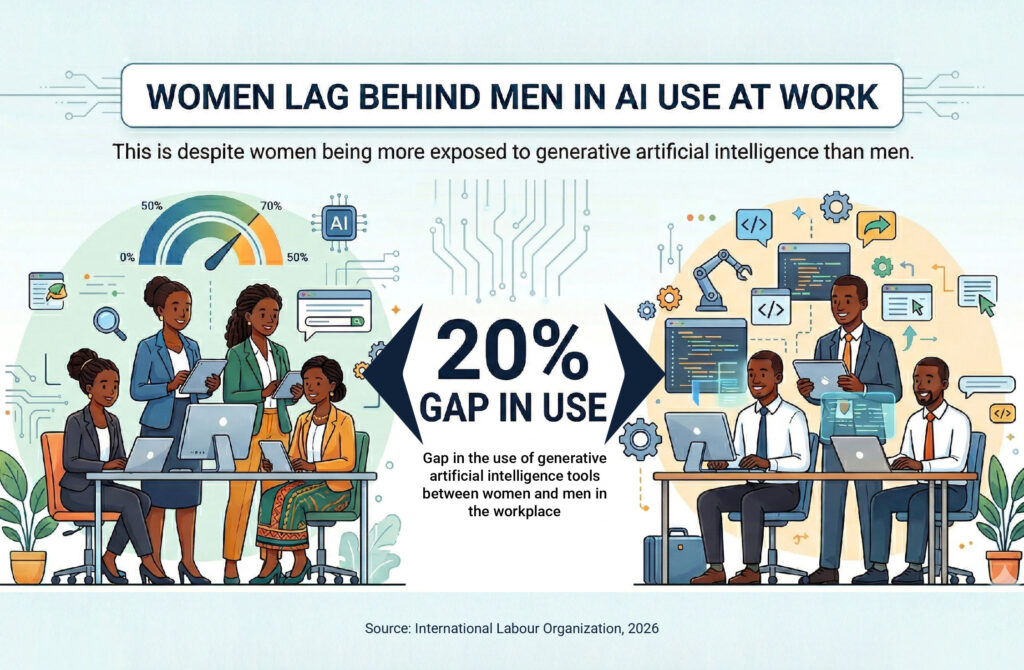
Journalists who can use these tools effectively are able to work faster, analyse information more efficiently, and respond more quickly to breaking news. However, there’s a gender gap in AI adoption affecting access to tools and decision-making power. In many newsrooms, men continue to dominate editorial leadership, placing them in a stronger position to influence how AI is integrated and used.
In addition, AI systems are not neutral and often reflect existing social and cultural biases. In journalism, this can influence how stories are framed, whose perspectives are prioritised, and what is considered authoritative.
According to the World Economic Forum, women hold less than 30 per cent of leadership roles in technology-related sectors worldwide—patterns that are echoed in the media.
Angela Minayo, a digital rights expert at Article 19 Eastern Africa, says these issues cannot be separated.
“We need to prioritise gender considerations,” she says. “It’s not optional; it’s required.”
She also points to growing safety concerns. For women journalists, the risks are not limited to access. Globally, research shows that women in media face higher levels of online harassment, and emerging technologies are making it easier to amplify that harm.
What’s missing
At the institutional level, Kenya has taken steps to respond. The Media Council of Kenya (MCK) has introduced AI reporting guidelines, incorporating artificial intelligence into the national Code of Conduct. MCK’s regional coordinator, Evans Oundo, says more than 500 journalists have been trained on ethical AI use.
However, a detailed breakdown of this data is not available, including how many of those trained were women, where they were based, or whether they were correspondents, freelancers, or staff reporters. It is also unclear how many came from rural areas, where access to such opportunities is often limited.
Oundo acknowledges that the current guidelines do not specifically address the challenges faced by women journalists.
“We need to go beyond this and develop initiatives that target women journalists,” he says.
Many newsrooms also still lack formal AI policies.
Adapting in Real Time
Even with these challenges, women journalists are continuing to adapt.
“Newsrooms need to be very deliberate in providing training opportunities,” Nakitare says. “Technology is evolving every day.”
Minayo’s message is direct: “Embrace it. The technology is here. Be curious, not just about the tools, but how they are shaping the world around you.”
Looking ahead
Every morning, Irene still goes on air, now with AI quietly part of her workflow. Naomi continues to experiment with the tools, building confidence one story at a time. Like many women journalists across Kenya, they are adapting to the technology. But as AI becomes more embedded in journalism, early patterns of access and exclusion are likely to shape the future of the industry.
The question is no longer whether women journalists will adopt AI, but whether they will have equal access to shape how it is used. Without deliberate investment in training, policy, and inclusion, the risk is not just a digital divide—but a widening gap in whose voices define the future of storytelling.
This article was produced as part of the Gender+AI Reporting Fellowship, with support from the Africa Women’s Journalism Project (AWJP) in partnership with DW Akademie. The journalist used AI tools as research aids to review and summarise relevant policy and research documents and extract key statistics. All analysis, editorial decisions and final wording were done by the reporter, in line with the Lake Region Bulletin’s editorial standards.

