More women building AI could mean safer and more inclusive technology, but their impact is limited by systemic gaps in representation, access and policy.
Imagine a woman in Kenya fearing for her safety.
She picks up her phone, types in her fears, and receives an instant response with practical, tailored advice: where to go, who to call, and what her rights are.
For many women, whose moments of fear are faced alone, technology now offers support built with their realities in mind. Female engineers, founders, and innovators are developing tools that centre women’s safety and voices, drawing from their own lived experience.
Among the innovators are Angela Kanyi and Aisha Mohamed Nur of Tech Innovators Network (THiNK). Together, they are building AI tools for communities often overlooked by mainstream technology. One of their creations is SheBot, a women’s safety chatbot developed in response to everyday safety concerns.
“We realised there was a need,” Angela says. “It was around the time when a lot was happening in Kenya with the safety of women. We didn’t have a central place where anyone could go and get readily available information at no cost.”
SheBot delivers immediate, free, and accessible safety information – from emergency contacts and legal aid to safe spaces – on basic smartphones, without judgement or delay. It is a simple idea with profound implications: safety information when and where it is needed most.
Tools like SheBot raise an important question: Does it matter who builds technology?
In many cases, the answer is yes.
Women developers often design from lived experience. This can mean prioritising issues that are frequently overlooked in mainstream tech — such as gender-based violence, privacy, trust, and accessibility. SheBot, for example, is grounded in the realities of navigating public and private spaces as a woman in Kenya.
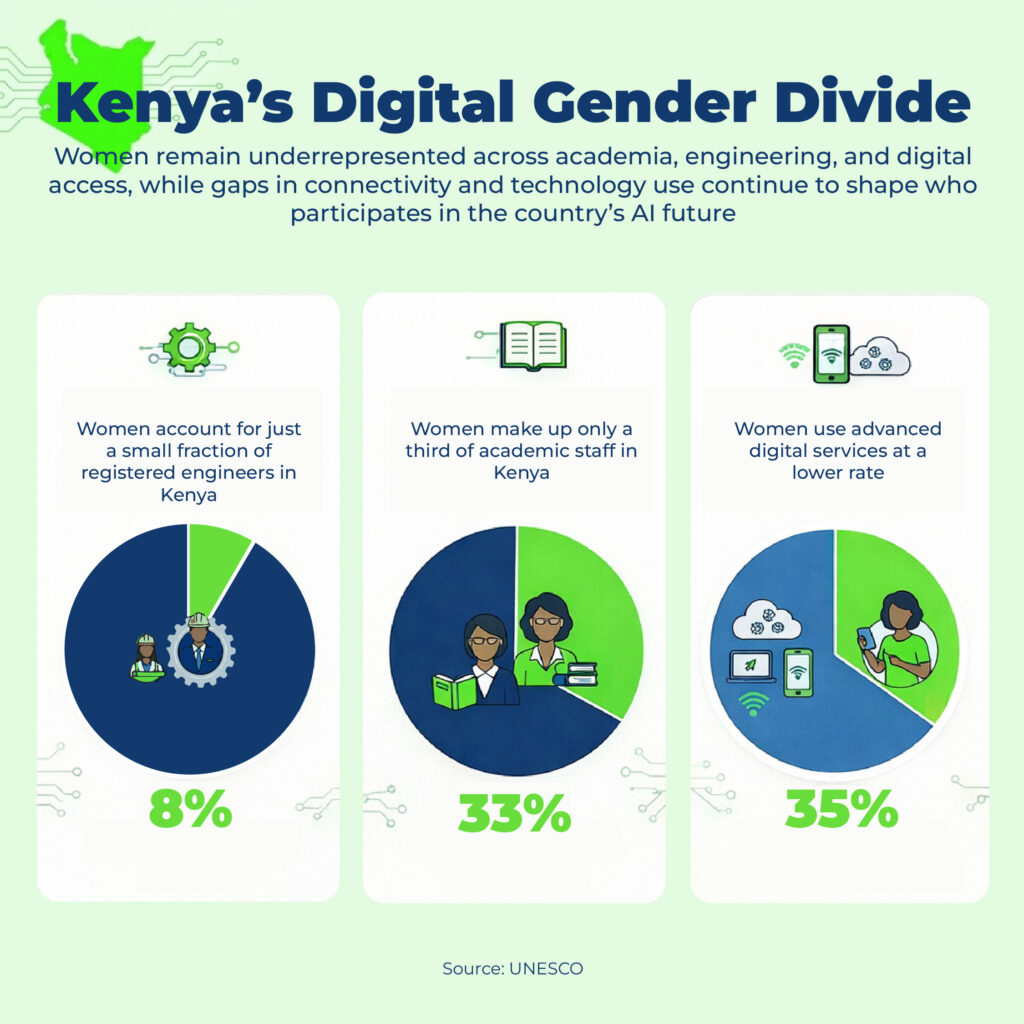
Yet, women remain under-represented in the spaces shaping the development of technological solutions. Data by UNESCO shows that only 8% of engineering roles in Kenya are held by women. Globally, Stanford University reports that just 30.5% of AI professionals are women.
“We’re under-represented,” says Aisha, THiNK’s lead AI engineer. “Finding female AI mentors is tough.”
This gender gap shapes what is built and what is not.
Inclusion also means addressing structural barriers – access to smartphones and the internet, especially for women in rural and marginalised communities.
Beyond innovation
Angela Minayo, a digital rights and policy programme officer at ARTICLE 19 East Africa, says the issue runs deeper than representation. She says there’s need to look at the entire ecosystem — who leads and makes decisions in tech companies and whose perspectives shape products.
“It’s beyond who is creating the technology,” she says. “It’s not just about women in STEM. It’s about women’s place in the world and how much we’re able to influence technology products.”
She points to the controversy around AI-powered smart glasses that were used to record and identify strangers in public without their consent. Such systems raise serious concerns about surveillance, harassment and misuse, particularly for women and children, yet they are deployed without considering these risks.
“In the entire chain, from conception of the idea to deployment, testing, and sandboxing, at no point was it pointed out that this could have a negative impact on women and children, especially from a sexual harassment point of view,” she says.
“Until that gap is filled, we will continue having these inequality issues and this disproportionate negative impact on women and minorities,” she adds.
Kenya’s Artificial Intelligence Strategy 2025–2030 signals growing national interest in AI, but, according to Minayo, it falls short on gender issues.
“A strategy isn’t the same as policy or law,” she says. “This isn’t regulation, just guidelines. We need actionable steps that address how tech will affect women.”
She says that institutions tasked with upholding equality must play a more active role and that gender perspectives should be embedded directly into AI governance frameworks. She adds that the National Cybercrime Coordination Committee doesn’t have a gendered approach.
“A gendered approach will mean having someone from the Gender Equality Commission sitting on this committee. It will mean spelling out gender guidelines in our policy documents related to ICT – the AI strategies, policies and any AI-related acts that will ever be passed,” she explains.
Despite the challenges of exclusion, women in Kenya’s AI sector are not waiting for systems to catch up. They are already building the future they want to see.
“If we didn’t build this, no one would,” Angela says.
She envisions a more inclusive and localised future for artificial intelligence – with more women, mentorship and a new generation of practitioners who won’t feel alone.
“I want AI to be localised – to understand African languages, accents, context, and needs,” she says.
By building tools with local experiences in mind, women like Angela and Aisha are reshaping what technology looks like — who it serves and whose realities it reflects.
This article was produced as part of the Gender+AI Reporting Fellowship, with support from the Africa Women’s Journalism Project (AWJP) in partnership with DW Akademie. The journalist used AI tools as research aids to review and summarise relevant policy and research documents and extract key statistics. All analysis, editorial decisions and final wording were done by the reporter, in line with the Lake Region Bulletin’s editorial standards.

