
For six months, 63-year-old Catherine Hagasa Mate barely slept, keeping watch over the fragile shelter she built in Shirulu Village, Kakamega County, after losing her land.
She remembers November 19, 2023, when she woke to the sound of shouting. An angry mob had gathered outside her parents’ home. By the end of the day, every structure had been torn down.
It was the second time she had been evicted. After her husband’s death, her in-laws cast her out and denied her access to her matrimonial land.
With four children and nowhere to go, Catherine returned to her childhood home, though her parents had long died. As the eldest married daughter (even though she was now a widow), she was not allowed to stay.
“My sister worked with extended family members and some local administrators to evict me so they could sell the land,” she says.
Rejected by her in-laws, turned away by her own family, and left without protection from local authorities, Catherine rebuilt from nothing. Well-wishers later helped her put up a small house, but the fear has never left.
Her story reflects a wider pattern. Across rural Kenya, widows and daughters are pushed off the land they are legally entitled to.
Culture overrides the law
The Constitution of Kenya guarantees women equal rights to property and inheritance. Courts have affirmed these rights, but even when courts rule in favour of women, enforcement is often weak.
For many women, the problem begins when they try to use the law. Lilian Ocharo, a land rights advocate, hears these stories daily in Bondo, Siaya County: boundaries moved, inheritance denied, and cases delayed in courts or chiefs’ offices until women give up.
“Most of the cases involve widows who don’t even know the law protects them,” she says. Even when they do, reporting is risky.
“They are afraid they won’t be heard. Or worse, that what they say will be passed back to the same people threatening them.”
Ocharo moves from office to office, trying to keep cases alive in a system that barely moves. Many collapse before resolution.
Rodgers Ochieng, CEO of Support Community in Democracy Alliance (SCODA), says cost and hostility push women out.
“Many women simply cannot afford it. And the offices where they go to seek help are not always welcoming. They get discouraged and walk away, leaving cases unresolved.”
Digital tools and their limitations
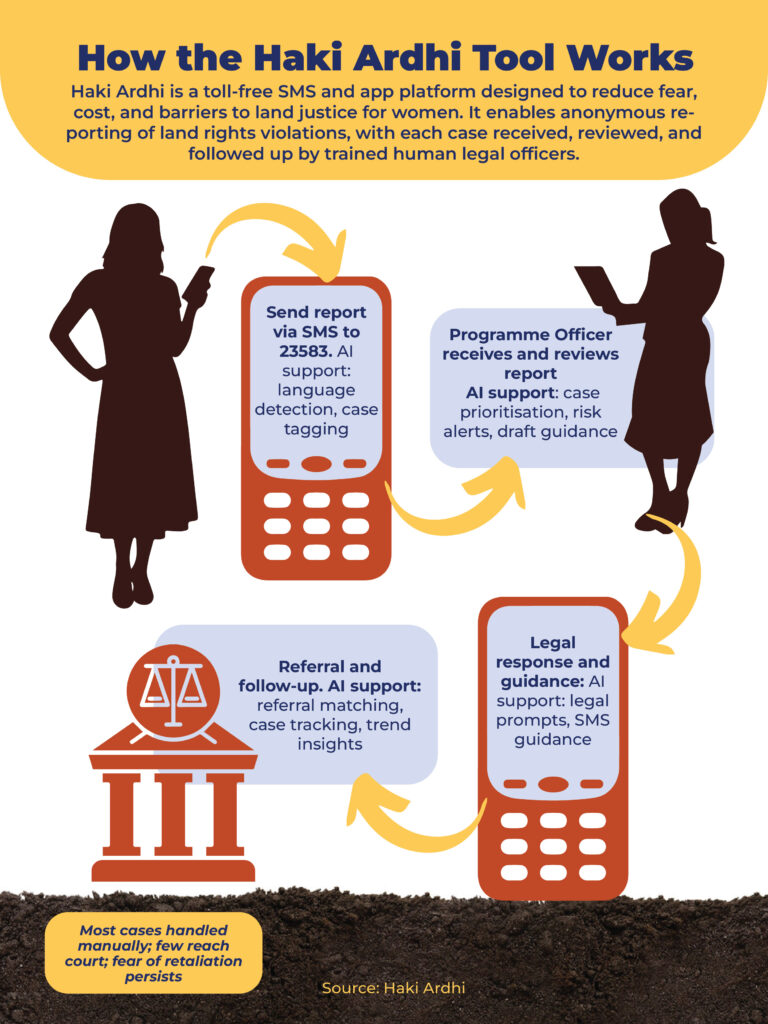
To address these gaps, Shibuye Community Health Workers, working with the Rainforest Foundation UK and the Kenya Land Alliance, created Haki Ardhi, a toll-free SMS platform for reporting land disputes by sending an anonymous text to 23583.
Behind every message is a staff member who reads, responds and guides women through the next steps.
“Women are afraid to report,” says Haki Ardhi’s Programme Officer Doreen Magotsi. “They don’t know what steps to take, and they fear retaliation.”
Since November 2024, the platform has received 727 reports of land rights violations across Western Kenya.
“Of the 727 cases received, only four have made it to court, one fully resolved, with the remaining 723 cases directly solved by the organisation,” adds Magotsi.
Reporting has improved, but outcomes have not. Many cases stall, are resolved informally, or are abandoned altogether.
In one case, a woman who sought help after using the platform was later threatened when relatives suspected she had reported them. She withdrew her complaint. The tool worked, but the system around it failed to protect her.
The promise and limits of AI
As digital tools expand, attention is shifting toward artificial intelligence. Already, the Kenya National Artificial Intelligence Strategy 2025-2030 signals that change is coming. Land services are already being digitised through platforms like Ardhisasa, which allows Kenyans to conduct land searches and transactions online.
There is hope that AI could track cases, flag land encroachment using satellite imagery, and guide women through legal steps. Similar systems are already used in countries like Brazil and India, where satellite mapping monitors land use and detects encroachment, though these tools are not widely accessible at the community level.
“AI could make it much easier for women to keep track of their land without always having to be physically present,” says Monica Nyaga of Participatory Ecological Land Use Management (PELUM) Kenya, which works on strengthening women’s access to land.
Rodgers Ochieng also sees potential in AI tools like legal chatbots.
“For example, if a woman’s property is being taken, she can use a chatbot to guide her on what steps to take and where to report,” he says.
But an AI chatbot could give incomplete or misleading legal advice, and a woman following it could lose her case without understanding why.
Technology does not operate in a vacuum. Land records still favour men, while many women’s claims remain informal or undocumented. According to the 2022 Kenya Demographic and Health Survey, 75% of women in Kenya do not own agricultural land, and 93% do not own non-agricultural land. When women’s land use is not documented, their claims are harder to prove, easier to dismiss, and less likely to move forward. Systems built on these records are likely to reproduce the same pattern, excluding widows, daughters and unmarried women who are often missing from official records.
Digitisation can help, but it can also erase. A digitised registry that excludes informal ownership could become the final authority, locking women out entirely. Predictive systems could also be used by land buyers, local elites or officials to identify contested land and claim it before women have a chance to act.
Digitisation also carries risks around privacy and consent. In tight-knit rural communities, where anonymity is hard to maintain, reporting through digital tools could expose women to retaliation.
Digital services are also often out of reach in rural areas. Many women still rely on SMS, chiefs and community paralegals, not apps or online platforms. Digital tools require basic access—owning a phone, being able to read and write, having network coverage, and affording mobile data. Many rural women lack one or more of these, leaving them unable to use digital systems and still at risk of losing their land.
“As a county, we are not there yet,” says Sindani Wellington, Bungoma County Director of Planning.
Land processes are still handled on paper, records are incomplete, and many people do not know where to start.
“There is simply not enough information reaching people in the villages,” he says.
Many women assume they must hire lawyers, not realising they can begin succession cases through local administrative channels.
Many of the AI tools being proposed have also not been widely used or tested in rural African contexts, yet these are the communities where they are being introduced most urgently. Systems built elsewhere may be applied in environments they do not fully understand, where land ownership is informal, contested, and shaped as much by custom as by law.
“There are real gaps in capacity and in how land ownership is structured, especially across generations. Many registration systems protect married women but leave unmarried women exposed and without safeguards,” says Nyaga.
Women with the least protection carry the highest risk when these systems fail. In these settings, errors can lead to lost claims, unresolved disputes, or women being evicted from their land.
In the end, the question is not just what technology can do, but whether it changes who has power. The system does not fail by accident. Those who control land and local decision-making benefit from delays and weak enforcement. Disputed land can be sold, transferred, or informally redistributed before cases are resolved, often favouring male relatives, local elites, or those with influence in administrative offices.
‘There are real gaps in capacity and in how land ownership is structured, especially across generations. Many registration systems protect married women but leave unmarried women exposed and without safeguards’-Monica Nyaga, pelum
For advocates like Ocharo, Ochieng, Magotsi, and Nyaga, the goal is not just to digitise and automate land systems but to make them work in practice. Technology can help, but it cannot fix weak enforcement or missing land records.
Catherine still sleeps lightly, not because she does not know her rights, but because knowing them has never protected her.
Technology may change how land is recorded and tracked, and digital systems may make these processes more efficient. But if the same people still control decisions, outcomes will not change. Land will still be sold, cases will still stall, and women will still lose their claims.
This article was produced as part of the Gender+AI Reporting Fellowship, with support from the Africa Women’s Journalism Project (AWJP) in partnership with DW Akademie. The journalist used AI tools as research aids to review and summarise relevant policy and research documents and extract key statistics. All analysis, editorial decisions and final wording were done by the reporter, in line with the Lake Region Bulletin’s editorial standards.

