It is a chilly morning in Juja town. Lagna Kiuria, a salonist, walks her five-year-old son past a public primary school less than ten minutes from her house. Inside the compound sits a county-funded ECDE classroom, one of many built in recent years as Kiambu expands access to early childhood education.
But Lagna doesn’t stop.
She continues down the road to a private preschool tucked behind a row of rental houses, where she pays nearly KSh10,000 every term.
“I know there is a public school nearby,” she says. “But when I visited, I felt my child would not get enough attention.”
Her decision reflects a quiet reality taking shape across Kiambu County, one where access to public preschool has improved significantly, yet many parents are still choosing to pay for private education.
Improved states of public ECDs
Over the past five years, the county government has invested heavily in early childhood development. New ECDE classrooms have come up across wards, teachers have been hired, and feeding programmes introduced to support enrolment.
In Juja Subcounty alone, there are 43 ECDE centres spread across five wards. Of these, 26 are complete and already in use, 14 are still under construction, and three have yet to begin.
According to the Juja Sub-County Pre-school Education Officer Martha Mbaire, the goal has been to bring preschool closer to families.
“We have made deliberate efforts to improve infrastructure and increase enrolment,” says Mbaire, adding; “Every ward now has ECDE centres, and we continue to recruit teachers to support learning.”
In many areas, the changes are visible, fresh classrooms, new desks, and a steady rise in the number of children enrolled.
For some parents, that is enough.
In Theta Ward, Jane Njeri, a fruit vendor, enrolled her daughter in a public ECDE centre attached to a nearby primary school. For her, proximity and cost matter most.
“The school is close, and I don’t pay much,” she says. “The teachers are trained, and my child is learning. For me, that is what matters,” she says.
With three children in school, she says private education at this stage would be difficult to sustain.
“If I go the private school way now, I may not manage later,” she adds.
Education more than just access
But for other parents, the decision goes beyond access.
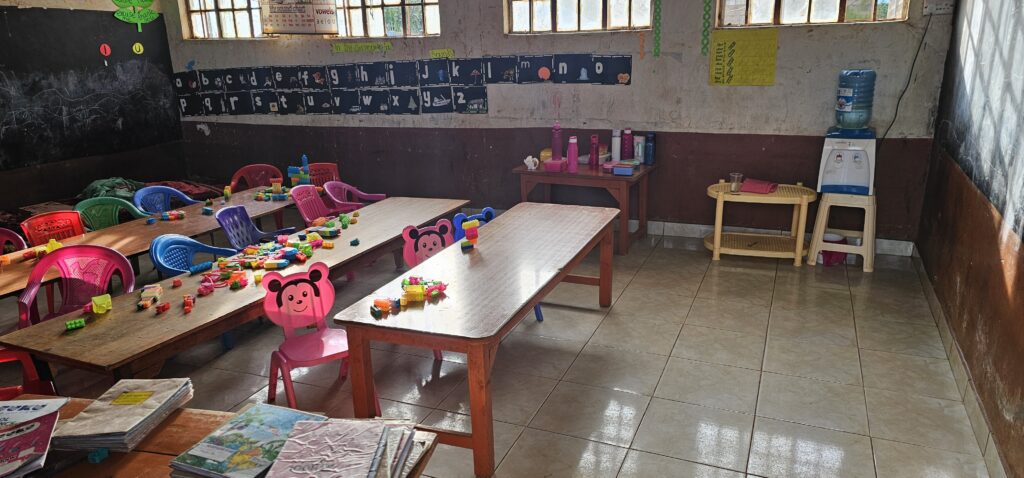
At Kalimoni ECDE centre in Juja, a classroom visit tells part of the story. The room is functional, desks neatly arranged, a blackboard at the front, but it holds 57 learners.
Teacher Miriam Mugweru is the Head of Department ECDE at Kalimoni Primary school and also PP2 teacher. She moves briskly between the pupils, trying to keep the lesson flowing.
“Sit properly… Finish your assignment before you go fo lunch,” she calls out.
She later speaks with us during lunch time.
According to Ms Mugweru, the county has really done a good job in improving access to Early Childhood education across the county. She however acknowledges that these successes comes with a bit of challenges.
“We appreciate the support from the county,” she says. “But when the numbers are high, it becomes difficult to give each child enough attention.”
County officials acknowledge the gap. While infrastructure has improved, staffing is still catching up with demand. In some centres, teacher-to-child ratios range between 1:30 and 1:40.
Juja sub-county has a total of 3194 ECDE pupils in both PP1 and PP2 with only 54 permanently employed teachers and 47 Board of Management teachers.
“We are working on recruiting more teachers. It is a process, but we are making progress,” says Mbaire.
A few kilometres away in Toll area, the setting is different.
At the Beach Academy, fewer than twenty children sit on colourful mats, guided through a lesson using blocks and picture charts.
“Who can show me number six?” the teacher asks.
Several hands shoot up at once.
For parents like Lagna, this is what makes the difference.
“When the class is small, the teacher notices everything,” she says. “If my child is struggling, I will know.”
Peter Mwangi, a mechanic, says he came to a similar conclusion after briefly enrolling his daughter in a public ECDE class.
“She would come home and say they spent a lot of time waiting,” he recalls. “When I visited, I saw how many children were there. I understood why.”
He later moved her to a private preschool, where he now pays about KSh 15,000 a term.
“It is expensive,” he says. “But when I see her progress, I feel it is worth the sacrifice.”
Private school operators say this demand has been growing steadily.
The secret in private ECDs
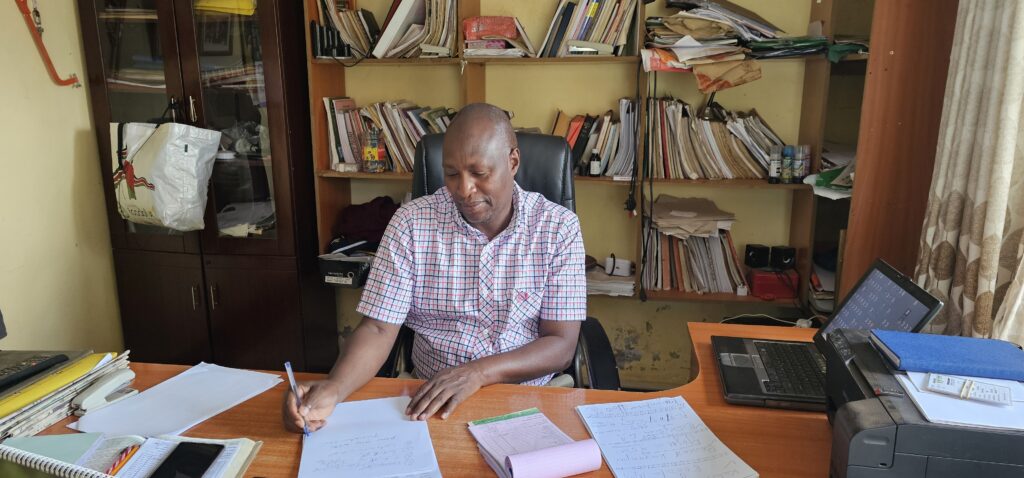
David Mwangi who runs a private preschool in Juja says parents are becoming more specific about what they want.
“Parents are not only looking at cost anymore,” he says. “They are asking about class size, safety, and how their children are handled in school.”
He says many also want assurance that their children are actively engaged in learning.
“At this level, children need attention and interaction. That is what many parents are paying for,” he adds.
His school keeps classes below twenty learners.
Even so, private education remains out of reach for many families, creating a gap that begins long before children join primary school.
Education experts warn that the differences emerging at this early stage can shape how children progress throughout their education.
Ken Echesa, an educationist and advocate of the high court says early childhood education forms the foundation on which a child’s learning journey is built.
“The nature and quality of education a child receives at this stage is critical to their development,” he explains. “It influences how they grasp concepts, how confident they become, and how they transition into primary school.”
According to Echesa, many parents associate private preschools with better quality, largely because of smaller class sizes and more structured learning environments.
“Parents want a strong foundation for their children,” he says. “That is why many of them lean towards private preschools, even when public options are available.”
He argues that while counties like Kiambu have made visible progress, similar investments need to be scaled across the country to address growing perceptions about public education.
“If the upgrade of ECDE centres is done consistently nationwide, it can help restore confidence in public institutions,” he says.
Echesa points to Rwanda as a model worth examining.
“In Rwanda, the public education system is strong enough that most families rely on it,” he notes. “If we can strengthen our public ECDE system in the same way, we can give all children a more equal starting point.”
Ms Mbaire agrees that most parents feel confident taking their children to private preschools, because of high enrollment is public centers which causes imbalance in teacher to child ratio in most public schools.
She however reassures that the county government of Kiambu is working on recruiting more teachers under.
“We have also had issues of insecurity in our centers mores so the stand alone ECDE centers, we have rolled out a program to erect perimeter walls around all the centers to ensure safety of the children,” she says.
Stand alone ECDE centers are centers with no primary schools attached to them
Back in Juja town, Lagna stands outside the preschool gate as the morning lesson begins. Children’s voices rise in unison as they recite the alphabet.
She glances briefly in the direction of the nearby public school, then back toward the classroom where her son is settling in.
The county government has brought preschool closer to home. For many families, that has made all the difference.
But for others, proximity is only part of the equation.
“I just want him to begin well,” she says.
And for that, like many parents in Kiambu, she is willing to pay.

