
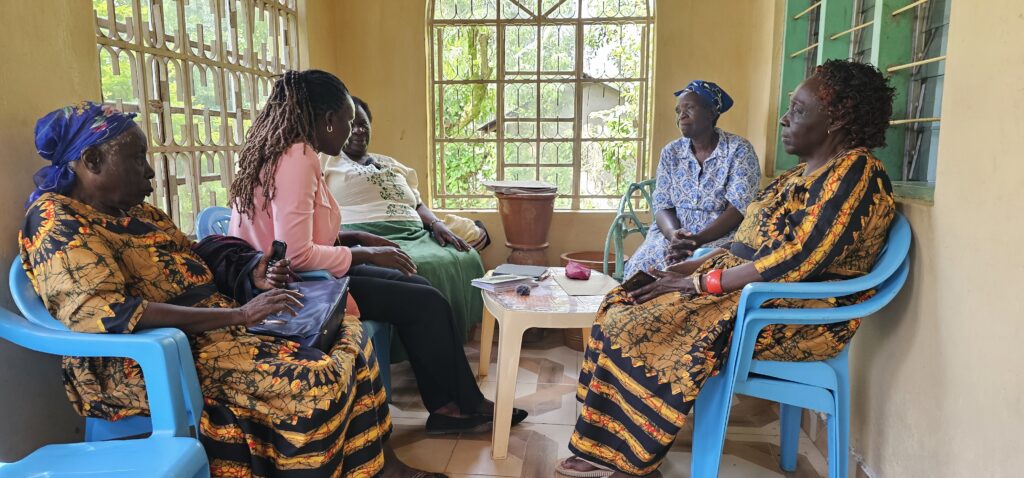
As the Monday morning sun slowly climbed above the horizon, radiating Ilesi village, some 20 women were converging at the home of Mama Abscondita Bunoro.
The women are members of the Crying Stone Widows Group which brings together widowed women from Ikhongo Murwi village in Lurambi, Kakamega County.
This weekly meeting is meant to discuss their empowerment strategies amid tough economic times worsened by their disadvantaged widowhood status.
“As widows, we face a lot of societal and economic challenges, so we have to stand strong or perish,” said Jane Ombeva, the group’s secretary.
When Lake Region Bulletin team visited the group, they were gathering at the home of the group’s Chairperson, mama Abscondita which is located a few metres from the famous cultural stone christened the ‘Crying Stone’.
Our visit was to dig out the intersection between the stone’s cultural narratives and the impacts of climate change in the area. We briefly joined the meeting towards the end of it, to catch a glimpse of their concerns.
Over a decade ago, such meetings would be soothed by sounds of chirping birds, croaking frogs, and buzzing insects emanating from the famous ‘Crying Stone’, which stands a sight away from the home. But that is now history.
Today, a palpable silence rules the village. No more buzzing movements of tourists thronging the stone to have a glimpse of its mystery tears. No more income for Ilesi women who pitched tent at the foot of the stone to provide tour guide services to the guests visiting the stone.
No more soothing sounds of birds and insects. No more rustling sounds of tree leaves swayed by free-flowing wind. And no more tear drops from the crying stone splashing in the surrounding.
The dried tears of the rock has left the village angry, hungry and thirsty.
Cultural narratives about the rock
At the foot of Kakamega Forest, in western Kenya lies this mysterious rock. Standing about 40 metres tall, and about 10metres in diameter, the rock hosts another smaller rock standing steadily at the top. Previously, water trickled down from the top where the smaller rock rests, down to the foot of the bigger rock, forming a tear-like flow.
This phenomenon earned the rock a name; the Crying Stone of Kakamega. However, even before the English name was coined, locals referred to it as ‘Ikhongo Murwi’ in the local Luyha language.
“‘Ikhongo’ means strength associated with power or authority, while ‘Murwi’ means the head. So the stone signifies a strong body where the head rests,” said Abscondita.
Various theories have been advanced about this mysterious rock, but two narratives stand out.
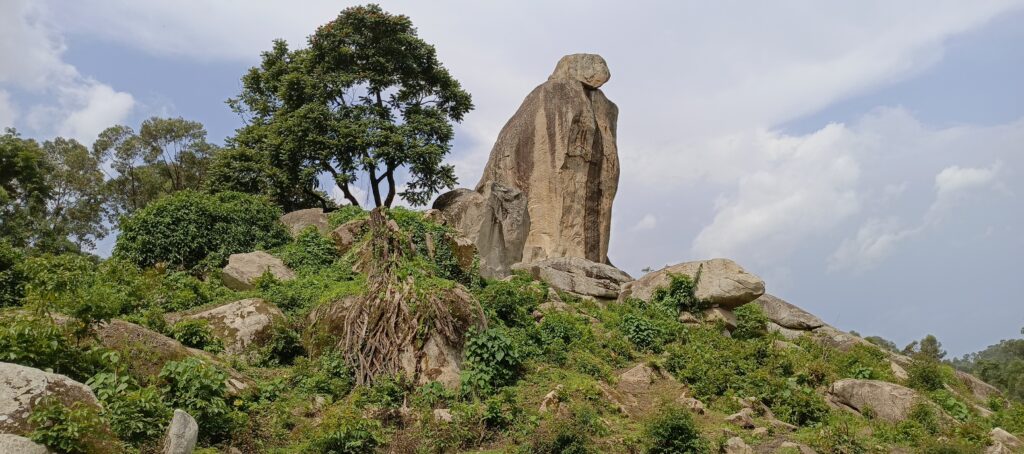
The first theory is that the stone represents a King in tears. According to the locals, there lived a King who got drunk with power, and began misusing his authority, especially through sexual molestation, never sparing both the old and the young.
The story goes that due to public wrath, the King was sent away to Egypt, where he lived for a long period of time before his despicable behaviours were exposed. It was then that Egyptians sent him back to Ilesi where he sought forgiveness.
The residents instead asked him to apologize while facing the direction where he had left his wife while he was departing for exile. Teary and remorseful, the King obeyed. It was then that he turned into a huge rock, while tears continued to flow.
However, with time, the tears have gradually dried up as the public anger calmed down.
This narrative has been passed from generation to generation, and when the Lake Region Bulletin visited the site during the production of this piece, a seven-year old grade One pupil at the foot of the rock corroborated it.
“I can share the story,” he murmured as we inquired if we could get a mature person of consent age to share the story. He meticulously retold the story, with daring confidence.
“Any time I am not in school, I come here to help guests understand the story behind the rock, and they leave me with gifts, including money,” he said.
Due to the small number of visitors to the stone, many of the older people rarely pitch tent there, as income has gone down, hence children are slowly taking over as they accept any gift, however little.
In another narrative, residents claim that the point where the stone sits was a battle ground between the two Kenyan tribes of Nandi and Luyha during the migration and settlement.
This theory states that, by the migration time, the said stone was already standing there, and that after long fights between the two tribes, they reached an agreement that whichever one of the warring sides that could dislocate the head of the stone and drop it to the ground would inhabit the land.
It was the Nandi that took the first stab at the challenge. They tied the ‘head’ with a rope, and strong men pulled, in order to roll it down. However, in every attempt, the stone did not move, and instead, it was the strong men who fell off the foot of the rock and died.
This signified defeat, and the Nandis had to move to the current Nandi Hills settlements, leaving the Luyha to occupy the land. The ‘tears’ flowing from the rock, they said, signified the sweat, blood and tears shed during the battle, and that with time, there is healing, hence the ‘tears’ dried off.
The pain behind the dried tears
Even as the residents hold onto these two narratives, they admit that the stone stopping to cry has left the village thirsty and hungry.
“As members of the Crying Stone Widows Group, we have our members who have been earning a living by providing tour guide services at the site. This is no longer tenable as the number of visitors have drastically gone down,” said Ms Ombeva.
She also notes that as the tears of the stone dried, several springs and streams within the area have also had their water levels drop so much that some even dry up during dry seasons thought by many to be the consequences of wider climate change.
But as residents ponder on whether the stone will ever resume crying, scientists point to what would appear to be a more complex reason as to why it stopped crying in the first place.
Professor Stanley Omuterema, a professor of Environmental Earth Science at Masinde Muliro University of Science and Technology (MMUST) associates the formation of the stone to volcanic activities millions of years ago.
He says the plutonic intrusive granite rock must have been formed underground over two billion years ago, when molten rock solidified to form magma. The hard rock, he notes, remained standing after the surrounding soft rocks were eroded.
He associated the tears with the flow from the rock, which he said to have been seepage from the ground through upthrust forces, which has since dried up due to massive environmental degradation in the area, as well as impacts of climate change, interfering with the water table and flow.
Professor Omuterema who has extensively researched and published on environmental issues in the area says it is possible to have the stone resume crying, but it will not be a mean feat.
“The cry and the tears signified life and it should continue for the community to feel living,” he said.
He notes that the restoration of the neighbouring environment, including the major water catchment area of Kakamega Forest, which has faced numerous threats, could be at the centre of the misfortune facing the stone.
“Issues such as unstained harvesting of trees from the forest, invasive farming, exploitation of the forest for wood fuel,and hunting must be addressed,” he told Lake Region Bulletin team which paid him a visit during the production of this piece.
He adds that addressing these threats will go a long way to counter other natural threats such as soil erosion, predator-prey imbalance, and other impacts of climate change which have affected rainfall patterns in the region.
“Conservation restoration is possible, and it must start with having the right tree and forest cover,” he said.
Through some of his research, Professor Omuterema notes that alarming findings such as reduced tree and forest cover, as well as increased unsustainable exotic trees stand out.
Multisectoral intervention to save the forest
Ms Penina Mukabane is the Kakamega County Executive Committee Member (Minister) for Water and Environment.
Born and raised in Kakamega, Ms Mukabane notes that she has witnessed the challenges facing Kakamega Forest, which include encroachment, illegal logging, and increased number of exotic trees such as blue gum which are posing threats to the environment.
“In fact when I was growing up, some parts of Kakamega town was part of the forest,” she said, adding that population growth, and development has put pressure on resources such as land.
According to records from the Kenya Forest Services (KFS), Kakamega Forest covers an area of about 23, 000 hectors. At least 14, 000 hectors of this is under Kakamega Forest Station, which borders Ilesi.
Apart from Kakamega Forest, the western Kenya region is one of the areas with favourable forest and tree cover compared to other areas in Kenya, making it receive a good amount of rainfall throughout the year.
Other forests in the region include; Malava, Bunyala, Turbo, Nzoia and Lugari.

Dennis Kerengo, the Western Kenya’s Regional Head of Conservancy at the Kenya Forest Services says the region has a 20 per cent tree cover which is above the national average of 12.13 per cent, while the region’s forest cover is 8.7 per cent forest cover, which almost matches the national average of 8.8 per cent.
Even as stakeholders point out to a threatened Kakamega Forest, Mr Kerengo says the forest is fairly protected compared to the other five in the region.
He however said that there are various strategies already being undertaken to ensure the forest is further protected.
One such intervention is the fencing off of the forest to control access by invaders. Through the support of Kakamega County Government and other stakeholders, an electric fence has already been erected in 22 kilometers out of the targeted 117 kilometres distance around the forest.
“Once it is fenced off, we can be able to control grazing, as this has been a major threat, since it has been difficult to ensure recommended capacity of grazing,” he said.
He noted that this will also help curb illegal loggers and charcoal burners.
“We are ensuring that we put access gates in strategic positions where the communities and other stakeholders can use to access the forest, but we will have rangers manning the entrances and exits to ensure no illegal activities within the forest,” said Kerengo.
“We have been engaging various stakeholders, and we have even put a target of increasing the region’s forest cover to 15 per cent by 2032,” he added.
Ms Mukabane said apart from this, the county government is also implementing other strategies such as empowerment of communities to reduce over dependence on wood fuel and other forest resources.
“We are providing alternative fuels, alternative incomes, capacity building of communities on importance of environmental conservation, and many others. All these interventions are aimed at helping restore our environment,” she said.
Walter Mwita, Assistant County Forest Conservator in Kakamega County says about 90 per cent of Kakamega Forest is under conservation/natural forest, while the rest is covered by plantation/planted forest, hence any invasion portends huge damage as it is difficult to restore conservation forest as such indigenous trees take so long to grow and regain its entire ecosystem.
Kenya Forest Services is mandated to protect, conserve and restore degraded forests in Kenya.
“Encroachment, illegal logging, and charcoal burning remain as some of the major challenges we face, but we are dealing with the situation,” he noted.
Even as the government and other agencies provide structured interventions to save this ecosystem, communities are in their own ways providing local solutions.
Local interventions
Irine Nasimiyu is a journalist based in Kakamega. Ms Nasimiyu is passionate about environmental reporting, but chose to go beyond her profession this time.
“I have been writing a lot about environment, choosing to focus on local solutions. I produced a number of print and broadcast stories, and I thought I needed to do more,” she said.
Three years ago, while engaging stakeholders in the environment and climate change sector, she came across an opportunity to do more.
“This particular organization was working with grassroots women to come up with innovative ways of environmental conservation, so I got interested and wanted to be part of it,” she said.
It was then that Ms Nasimiyu enrolled to be trained on making briquettes. She was expected to get back to her locality and pass on the knowledge, for greater impact.
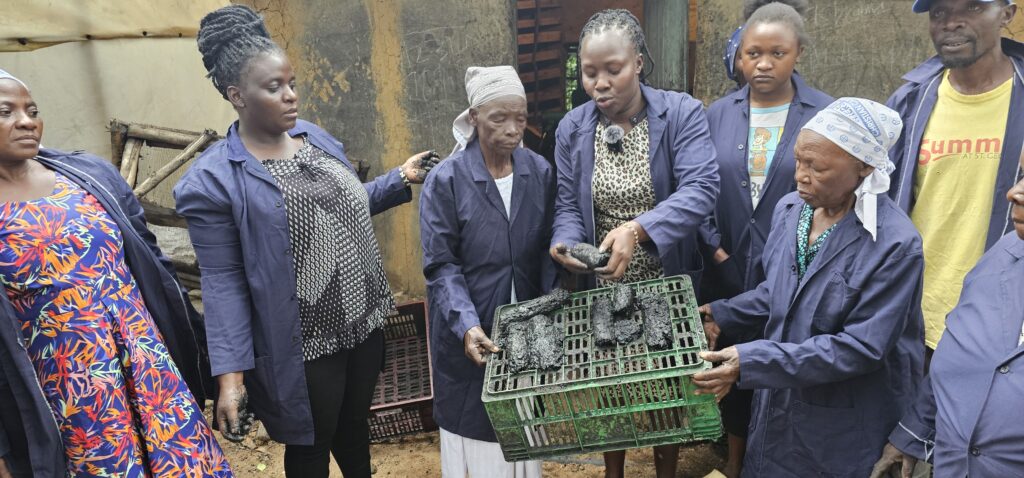
Last year, Ms Nasimiyu mobilized 20 women in Emusonga village, and trained them on briquette making.
And when it looked like the venture would be viable, they registered New Recada Women Group, which they are now using to scale up the trade.
According to Ms Nasimiyu, targeting women was like using one stone to aim at several birds in the conservation journey.
“In this society, the kitchen belongs to the women, and they are the ones who feel the heat when it comes to wood fuel. They will have to invade trees in order to get the fuel,” she said.
She noted that women are also engaged in small scale agriculture, hence are potential threats to the environment, especially if not capacity built on sustainable agriculture.
Shufa Auma is a member of this group. Ms Auma runs a small eatery adjacent to the neighbouring Chief Mutsembi primary School.
Previously, Ms Auma spent between KSh300 and KSh400 per day on wood fuel.
“Today wood fuel is scarce and the demand has seen the prices soar. This was making my hotel business unviable, and when I joined this group, I have found a solution to this,” she said, adding that she has since cut the expense on wood fuel, and now uses briquettes they make.
The group has a schedule for making briquettes. The members come together to collect charcoal wastes, sawdust and molasses, which are the key raw materials for making the briquettes.
Through the support of GIZ, the group managed to acquire a briquettes making machine, which has made it easier for them to manage mass production.
“We previously used our bare hands to mold the briquettes. Today we use the machine which has the capacity to produce up to 50 sacks of briquettes per day,” said Auma.
Each sack weighs 50 kilograms. Due to the processes involved in acquiring and preparing the raw material, they only engage in the production once a week.
“We can escalate this depending on the demand,” added Auma.
Florence Muketi is also a member of the group, and provides space for the group to undertake their activities.
When Lake Region Bulletin team visited the women on a Sunday afternoon, they were having their weekly meeting to strategize on the next week’s activities.
Neatly dressed with branded dark blue overalls, they sang, danced, prayed, chanted, and exchanged pleasantries during their meeting.
“This is not just an economic empowerment meeting, but it is a learning session which makes us have a grasp of issues affecting our environment,” said Ms Muketi.
As we engaged with the members, motorcyclists came in and left with sacks of briquettes, with each roar of a motor eliciting smiles in their faces.
“Today we supply briquettes to Kisumu, Nairobi, Eldoret, Bungoma and other places. We use the money we get from this venture to empower ourselves as it has become one of our key source of income. Part of the money we save for acquiring raw materials, as well as other logistical expense of the group such as repairing the machine, among other expenses,” said Nasimiyu.
To scale up the production of briquettes, Ms Nasimiyu says they are already looking into venturing into use of bagasse briquettes.
“We are surrounded by four sugar millers, and we have made contacts with them on how we can get bagasse,” she said.
She noted that the factories spelt out requirements which they are yet to meet, including committing a lorry for picking the bagasse from the factory, setting up a kiln where they will burn the bagasse, as well as providing a reasonable space where the material can be stored.
“Currently we are using the home of one of our members, which is not enough. We also lack the financial muscle to put up a kiln and commitment to hire or acquire a lorry for transporting the bagasse. We are constantly consulting, and we are hoping that our dream comes true,” she added.
She said venturing in bagasse briquettes will provide a huge boost to environmental conservation, since today they still rely on charcoal waste, which still promoting charcoal business.
“We have been showcasing what we do in different exhibition events, and we have come to a realization that our small contribution may have a huge impact on the environment,” she said.
And as New Recada Women Group explore on innovative interventions for both economic empowerment and environmental conservation, Crying Stone Widows are not left behind.
Crying Stone women in search of alternatives
At Ilesi Market, an array of clay products are beautifully arranged along Kisumu-Kakamega Road. They include pots, flower vases, stoves, among others.
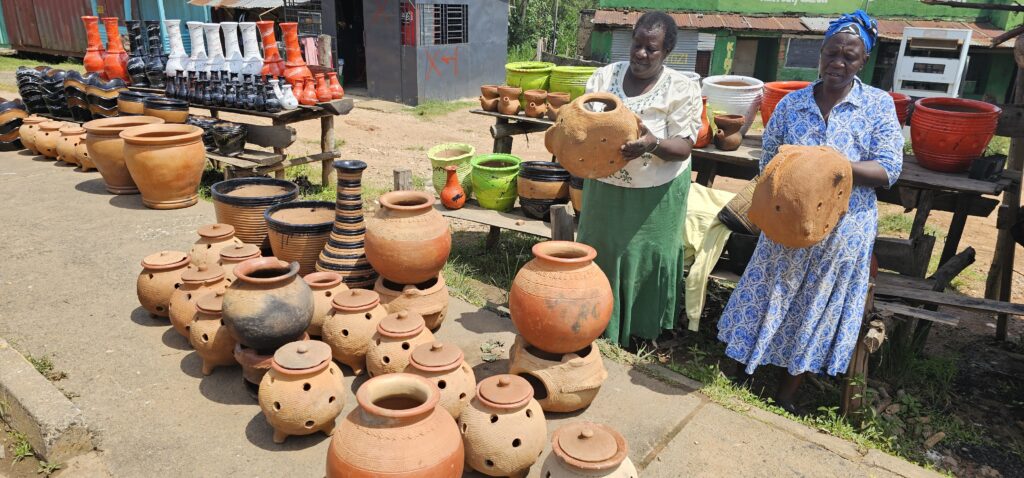
Ms Ombeva said members of the group chose to diversify their income sources by utilizing the huge masses of clay soil in their surroundings to make these products.
“These clay stoves are designed to reduce wood fuel consumption. You can use just one firewood to cook at a time, as compared to the open three-stone traditional stoves,” she said
She noted that the modern stoves also reduces the amount of smoke emission when cooking, hence playing a huge role in environmental conservation.
“We make the stoves in collaboration with other individuals and groups, then we install for people in their houses at a cost,” she said.
She says this diversification is also playing a huge economic boost to the women as income from the crying stone dries up.
Even as the cultural story of the stone remains anchored in their beliefs, Ms Ombeva admits that there is need for the community to listen to the scientific version of it in a bid to restore the environment if the stone is to resume crying.
By Kevine Omollo and Winnie Ali
This story was funded by climateXchange (cXc), a nonprofit initiative dedicated to helping global newsrooms enhance local climate storytelling and its intersection with cultural narratives.


Nice read. Insightful information of unknown details from renown natural resources.
Great article, interesting historical information and the current conservation efforts to save our forests. Great work