
Seven years ago, Agnes Wekesa contemplated selling her family piece of land, and use the money to start a business.
This was after several seasons of poor harvest which saw her stuck in cycle of unproductive farming.
Despite farming being the family’s main source of livelihood, Ms Wekesa was ready to make a huge gamble.
“My farm was full of murram, and the much we could harvest from the farm was a paltry 10 kilos of maize and that was so discouraging,” she told Lake Region Bulletin during the 2025 World Soil Day held in Kisumu on December 5.
In 2018, Ms Wekesa was enrolled in ProSoil project. The GIZ (German Development Cooperation) project working on combating soil degradation and improving food security by promoting climate-smart, agroecological farming practices, especially in Western Kenya.
“I thought I needed to be part of the project and see if it could be the solution to our poor harvest,” she said.
It was here that she interacted with soil protection initiatives such as vermi-culture, compost manure generation, push and pull, inter-cropping among others.
“In my new life, I was introduced to testing soil before could begin the new planting season,” she said.
And with each passing season, Ms Wekesa began to see the results.
After the first test, she was advised to use four tonnes of manure to help in boosting my farming and yields.
“I also practised minimum tillage, cover crop, crop rotation and in the first year, I harvested three bags of maize. I continued and implemented push and pull, vermi juice and agro-forestry, and this year alone, I managed to harvest eight bags of maize,” she quips.
Transformed soils
Today, Ms Wekesa is is a Community Resource Person (CRP) in her Kimaswa village, in Cheptais, Bungoma County as well as a Trainer of Trainers (ToT) on healthy soil.
“Apart from farming, I also practice value addition from the plant products. For instance, I plant mucuna (an annual climbing legume that fixes nitrogen into the soil gown as a cover crop to improve soil properties and crop yields). From mucuna sales alone, I make approximately Sh3,000 per sale,” she said.
Just like Ms Wekesa, Doris Atieno from Siaya is also a beneficiary of the project.
From her small parcel within her compound, she is able to practice suystainable agriculture which she says has boosted her harvests.
“From the project, I have been taught push and pull, gapping, agro-forestry and vermiculture among others,” she said.
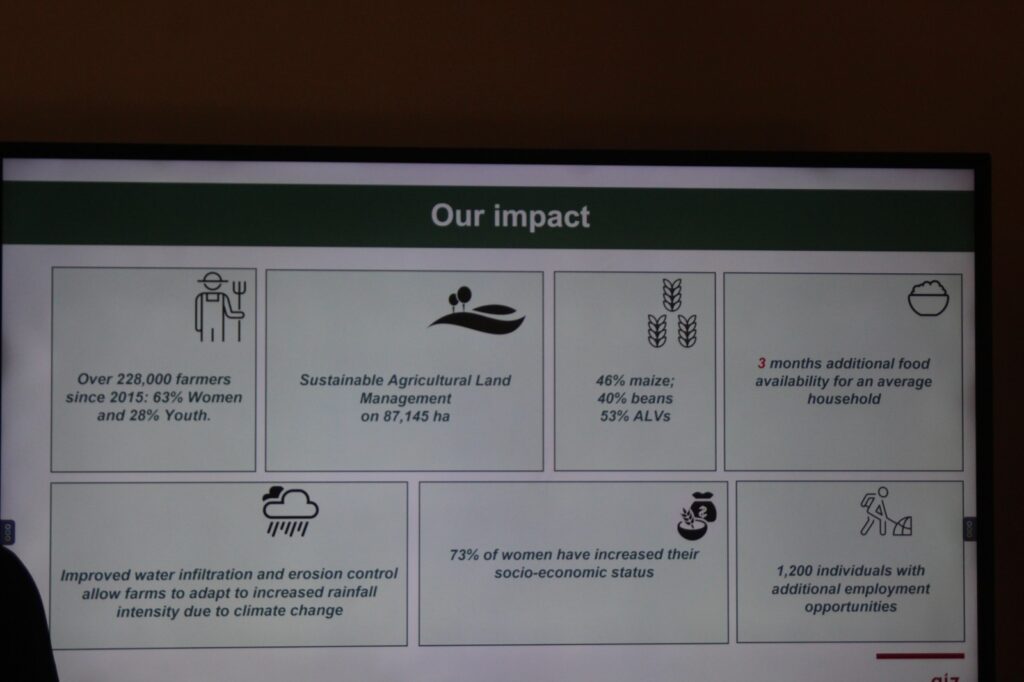
The project also covered the training extension staff and farmers in techniques like conservation agriculture, integrated soil fertility management, and agroforestry to restore soil health and boost yields.
With the project set to come to an end at the end of 2025, Project Manager David Kersting said atleast 228,000 farmers benefited from the project since 2015, with 63 per cent of the beneficiaries being women and 28 per cent being youth.
At least 73 percent of women have been socio-economically empowered from the project, which is being implemented across three counties namely; Bungoma, Kakamega and Siaya Counties.
The project aimed to combat soil degradation, improve food security, and build climate resilience for smallholder farmers.
Since its launch, the program has helped protect and rehabilitate over 980,000 hectares of land, resulting in an average yield increase of 44 per cent and benefiting the lives of 2.6 million people.
The implemented measures have reduced the carbon footprint by approximately 1.74 million tonnes of equivalent, leveraging healthy soils as a significant carbon sink.

